BREX: Fantasy Adventure about Seeds
If anyone is interested in taking a look at my old unfinished story, here’s the link: https://nathanparkinson.com/brex.

If anyone is interested in taking a look at my old unfinished story, here’s the link: https://nathanparkinson.com/brex.
I am very excited to share that I am creating a webcomic called Any Here Now (NEHN)! You can learn more about the comic itself on the dedicated page: https://nathanparkinson.com/any-here-now/.
Here I want to elaborate a bit on why I’m making this. For the last year I have been working to improve the quality of my illustration through Tim McBurnie’s Line and Color Academy (LCA). Stages 1 and 2 helped me establish a consistent drawing practice and a simple, reliable process for making art. If you’ve been following along for the last year, you have seen the results of my efforts. In stage 3 I am currently focusing on making and measuring progress. The specific area of progress I have been focusing on is intentionally incorporating abstraction into my work. So far in LCA I have mostly restricted myself to single one-off images to avoid getting too involved with story. I’ve been happy with the results, but my illustrations have generally been detached from one another, except being related in subject matter or theme. Recently I have been trying to weave some story to connect my illustrations while still keeping them separate.
I’ve heard Tim say many times that creating comics is a tremendous way to improve one’s skills by increasing drawing mileage. I also fell in love with the idea of comics when I read Scott McCloud’s Understanding Comics a couple years ago. I never read comics growing up, and it’s only been in the last few years that I’ve had any considerable exposure to them at all. Therefore it’s no surprise that I had never made a comic, even though I had dabbled with the idea a few years ago and even roughly pencilled several pages before concluding it was more work than I was looking for at the time (besides, I couldn’t stand those ugly speech bubbles mucking up my pretty art!).
Recently Tim suggested I give comics a try as a way to reduce the amount of new visual library / subject matter I needed to learn with each image. I started with a 1-page comic. Next I did a 3-page comic. Writing those stories broke a dam of ideas in my mind which has been flooding ever since. I recently learned of the work of artist Minna Sundberg; I was blown away by her comics and was very inspired by her artistic journey. I also remembered the Team Fortress comics I was introduced to a few years ago; I love the way they make their comics into a sort of animatic – it’s so engaging! – so I decided to try building my own webcomic viewer to recreate that experience for my own comics; I built the viewer with the assistance of Perchance’s AI helper and am super happy with the result (you’re welcome to use it however you wish or even fork your own version): https://nathanparkinson.com/webview.
While I generally love drawing and making pictures for the sake of it, I find it so much more rewarding to incorporate my art into a story and for it to serve a purpose, not just to look pretty. So, as a way for me to draw more, develop my ability to use abstraction, tell a story with my art, and create something that might possibly matter to more people than just me, I plan to create a practice webcomic (in place of my one-off illustrations) for the foreseeable future.
Without further ado…
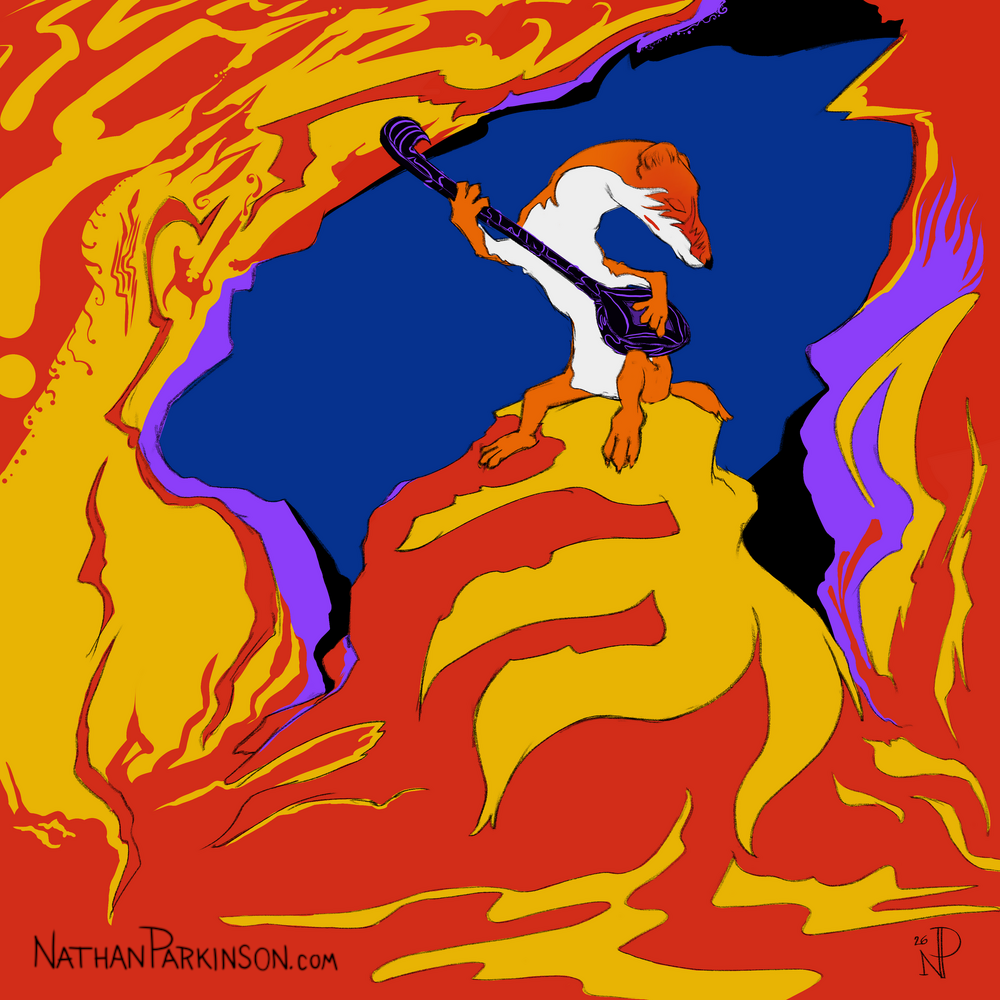
This was an interesting piece for me. It’s one of the first that I’ve completed where I was drawing abstract thumbnails with the intention of it being a weasel. I’m trying to figure out how to harness the compositional, intuitional interest of automatic drawing and doing so with intention.
I don’t absolutely love it, but I feel there’s something here I want to lean into. I am not really sure what was going on with all of the interesting shapes; I was attempting to make something interesting out of them and not have everything be totally random/ugly. I don’t really like that part, but I’m not sure how to improve upon it. I suspect I will get better ideas the more I do it. Overall, I think this piece was a win.
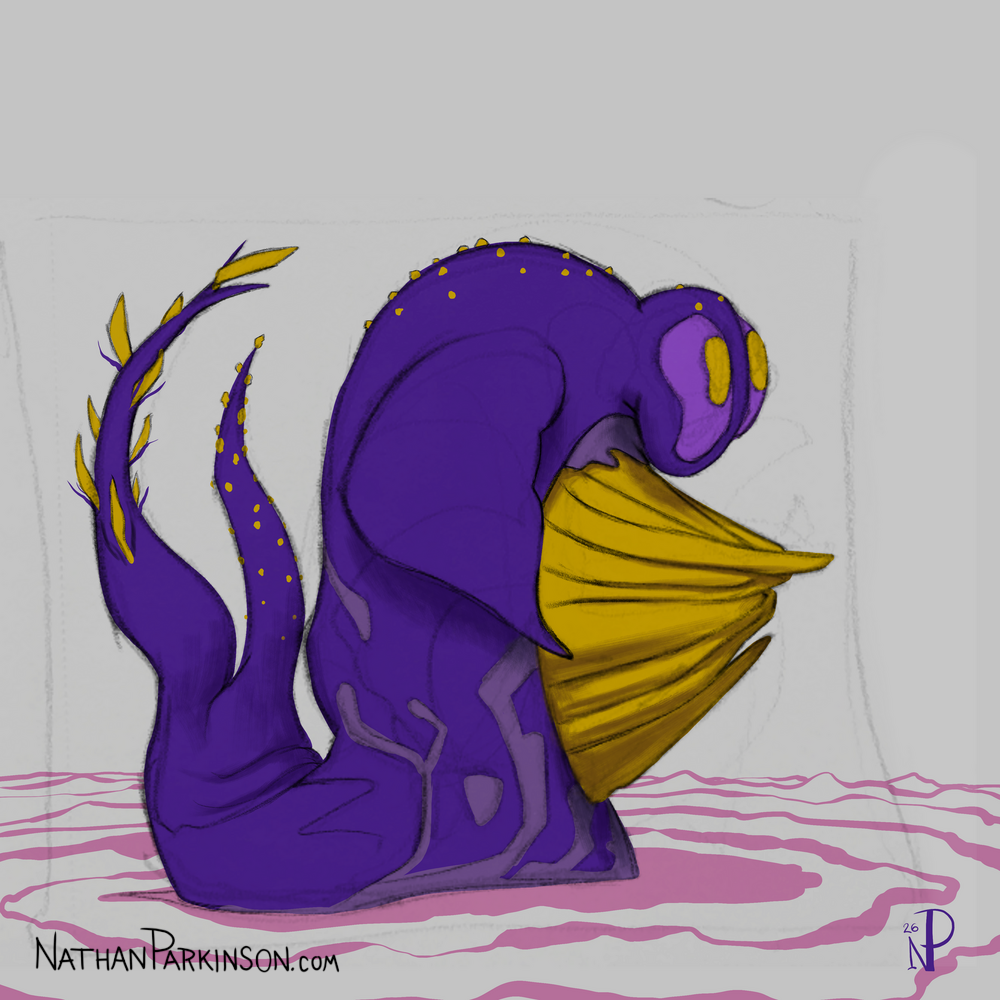
Another design based on a warm-up thumbnail. I didn’t really intend for it to become a creature, but I just started to refine the thumbnail and this is what emerged.
I liked the shapes in a thumbnail I did warming up; so I decided to refine it a bit and add some colour.
I’ll probably be sharing a lot more abstract work moving forwarding as I explore how to incorporate this part of me into my art style.
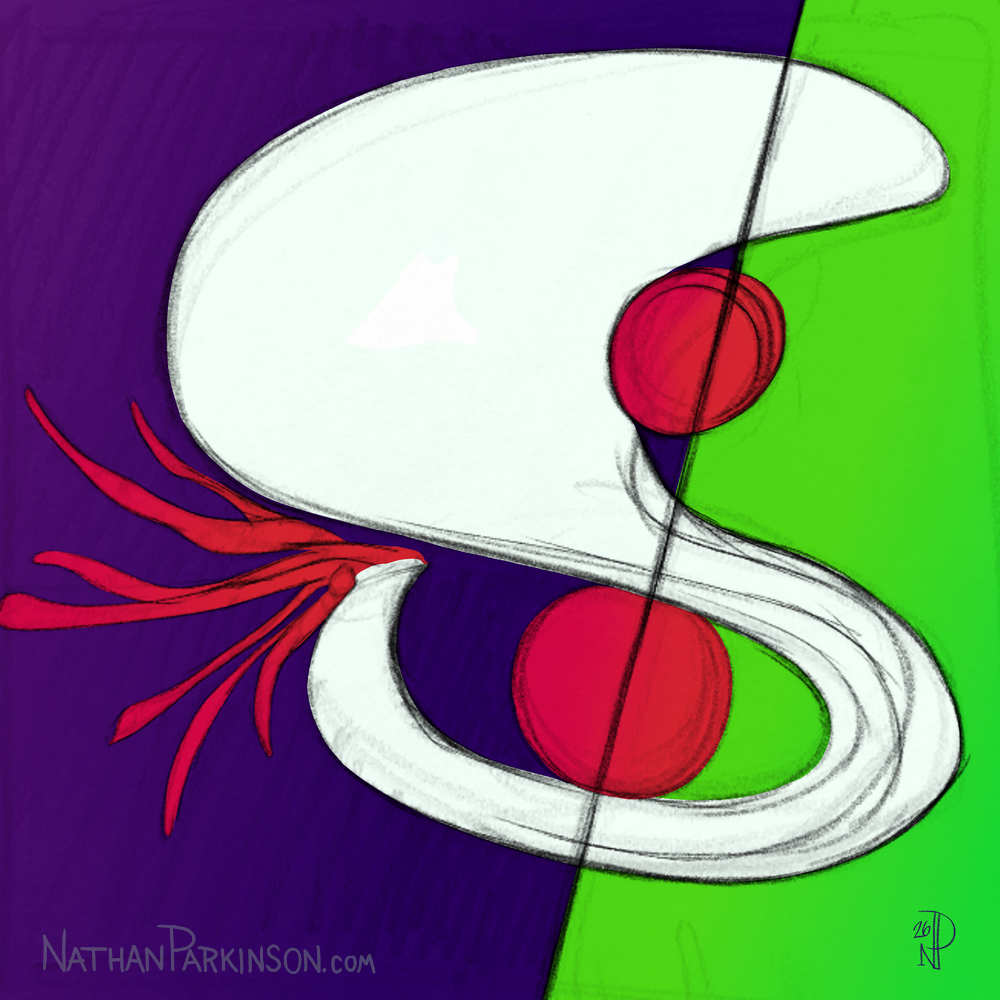
In the wide white terrain suddenly there appeared through the cover a jolly little critter. “Weasel’s the name,” he began with a smile.

I had the idea to make this little weasel blend into the background a bit. I rather like the result. It could be fun to do an entire book of forest creatures in the winter.
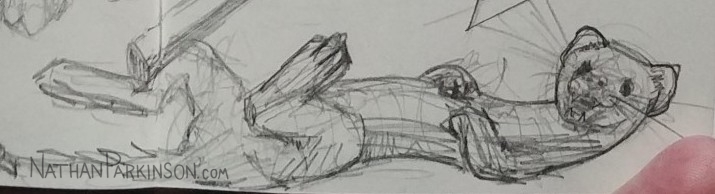
I’m excited to share that I have completed Stage 2 of the Line and Color Academy. To recap what I completed in this stage, I did 26 letter illustrations for AlphaCon, 20 character portraits, and 20 full-body illustrations of anthropomorphized characters . . . and it only took me 6 months :). You can go back and see a lot of the work I shared in previous blog posts.
Stage 2 was about learning a simple, reliable process. Stage 3 is about making and tracking reliable progress; to do this effectively, it’s best to pick a very specific thing you want to improve at and then put in consistent effort and track your progress over time.
To begin Stage 3 I’ve chosen to try improving at characterization, the expressiveness of the characters, the interest of the character design, the caricaturing through anthropomorphism. I spent the last 3 weeks daily studying and drawing weasels, trying to really understand them so I can create convincing weasel characters. My previous 20 anthropomorphic characters were done with almost no prior study of the creatures I was drawing. I had drawn them a little bit over the last several years, but never in-depth study to really try to understand them. I relied mostly on memory of what they look like, my ability to construct bodies and form, and a bit of photo reference for some just-in-time learning.
In this post I share some of the sketches and studies from my time studying weasels to show you a bit of what goes into this sort of learning.
I began by observing photos and videos of weasels and stoats just trying to get an understanding of them – how they move and act, their behaviour.
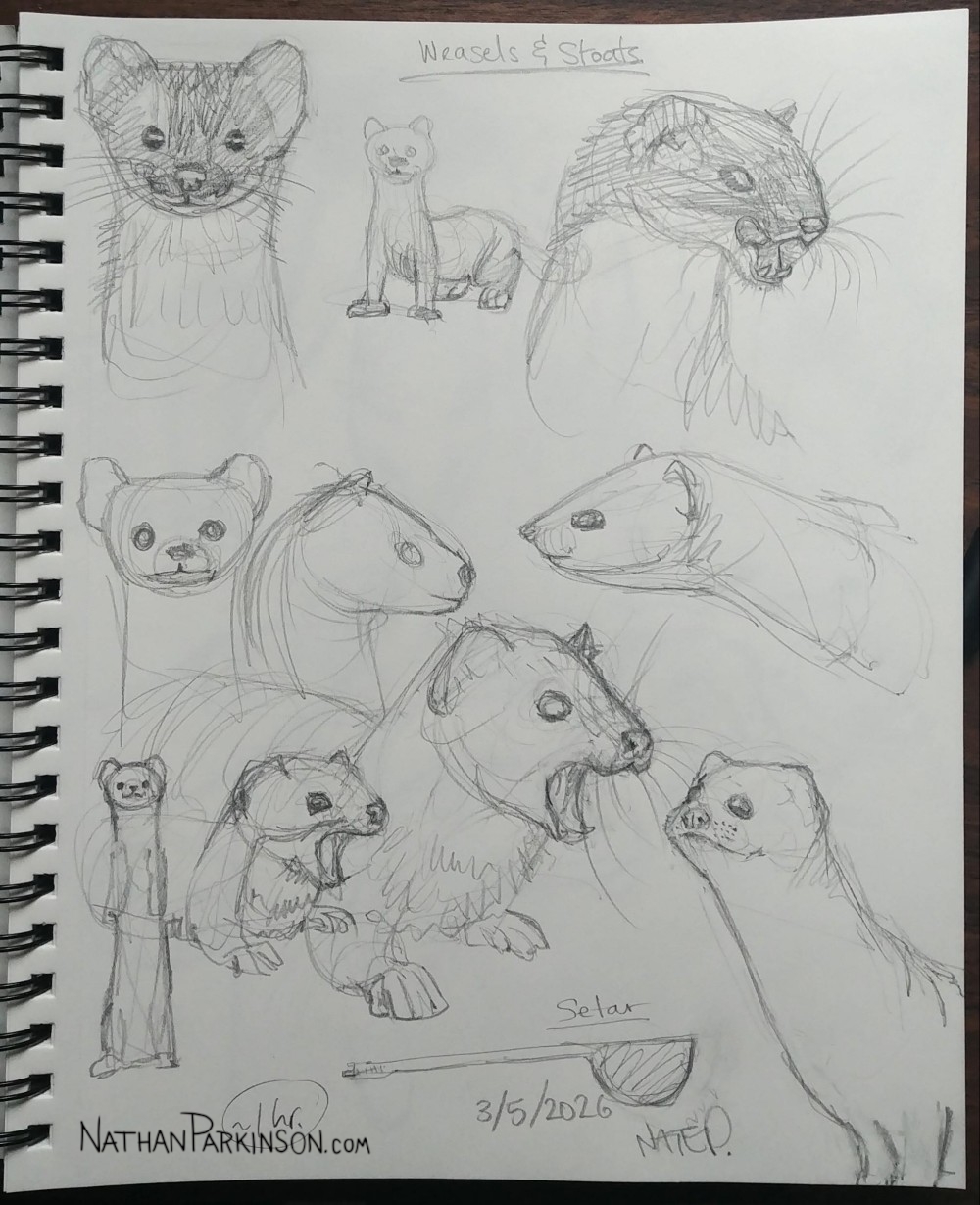
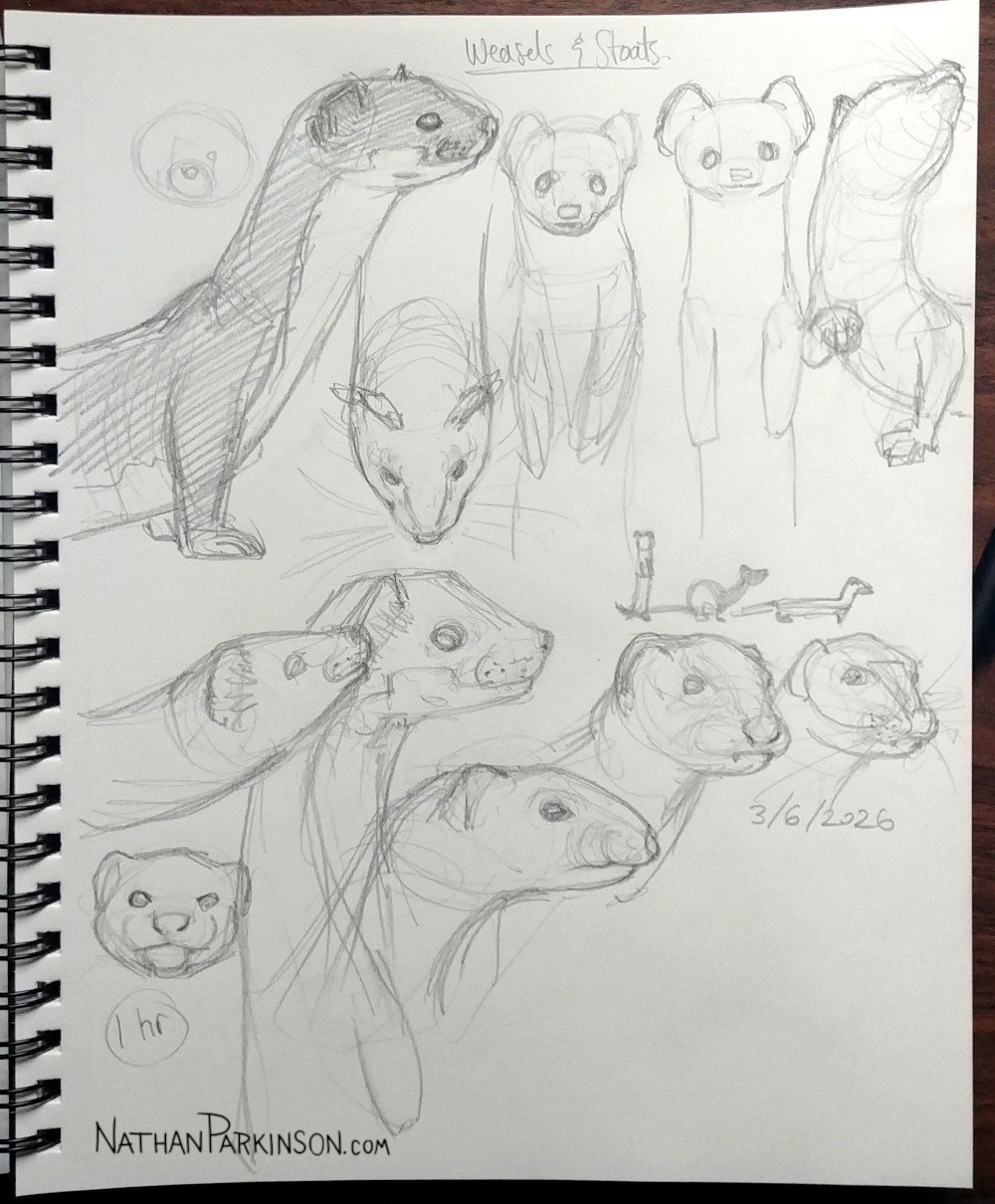
The following sketches were done while I was at an event and didn’t have any photo reference with me; so I had to rely on what I could remember of what I had studied the week before. I partly incorporated some of what I was seeing in my surroundings. This gave me a good chance to start applying what I had learned about the weasels into drawing my own characters.
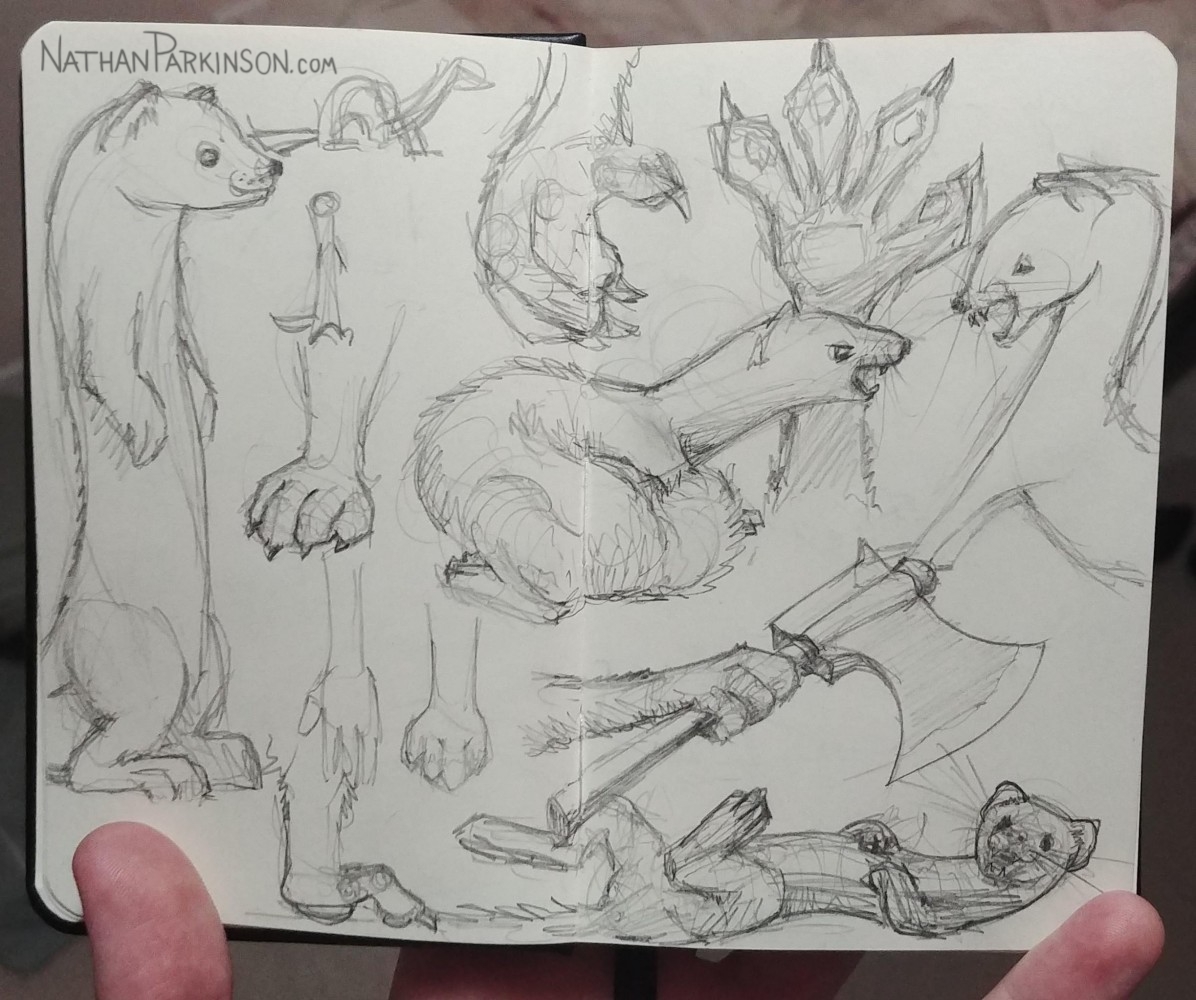
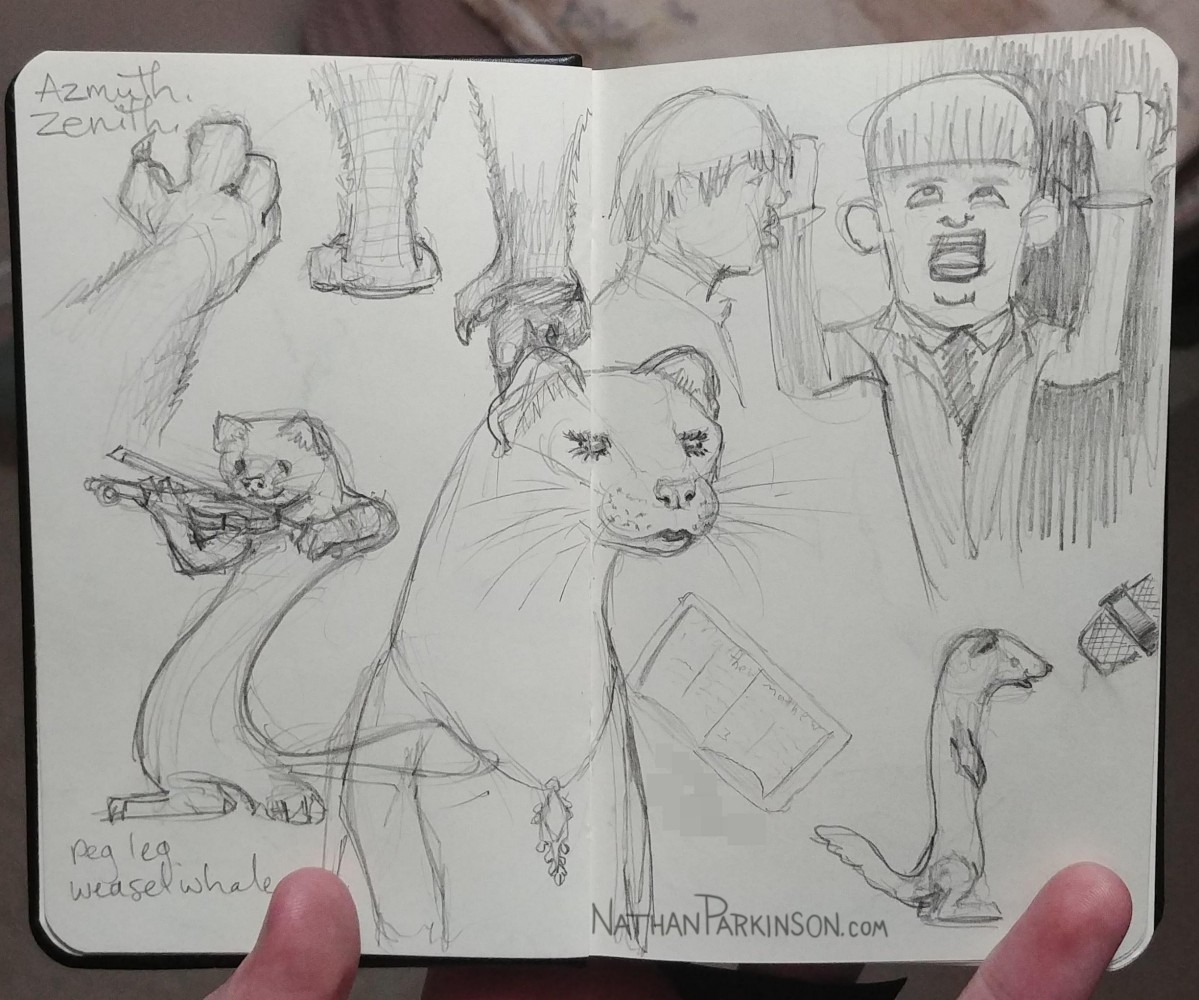
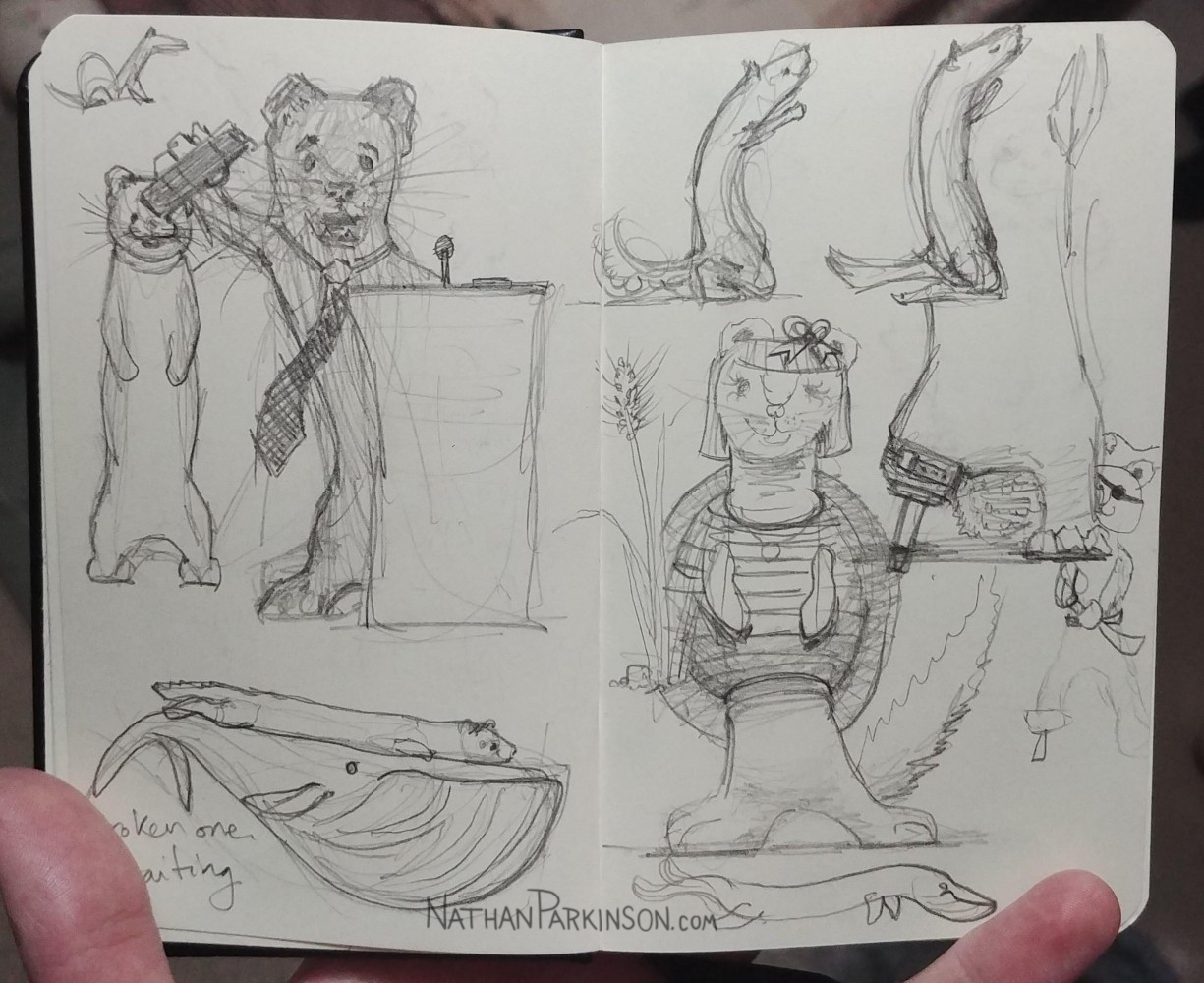
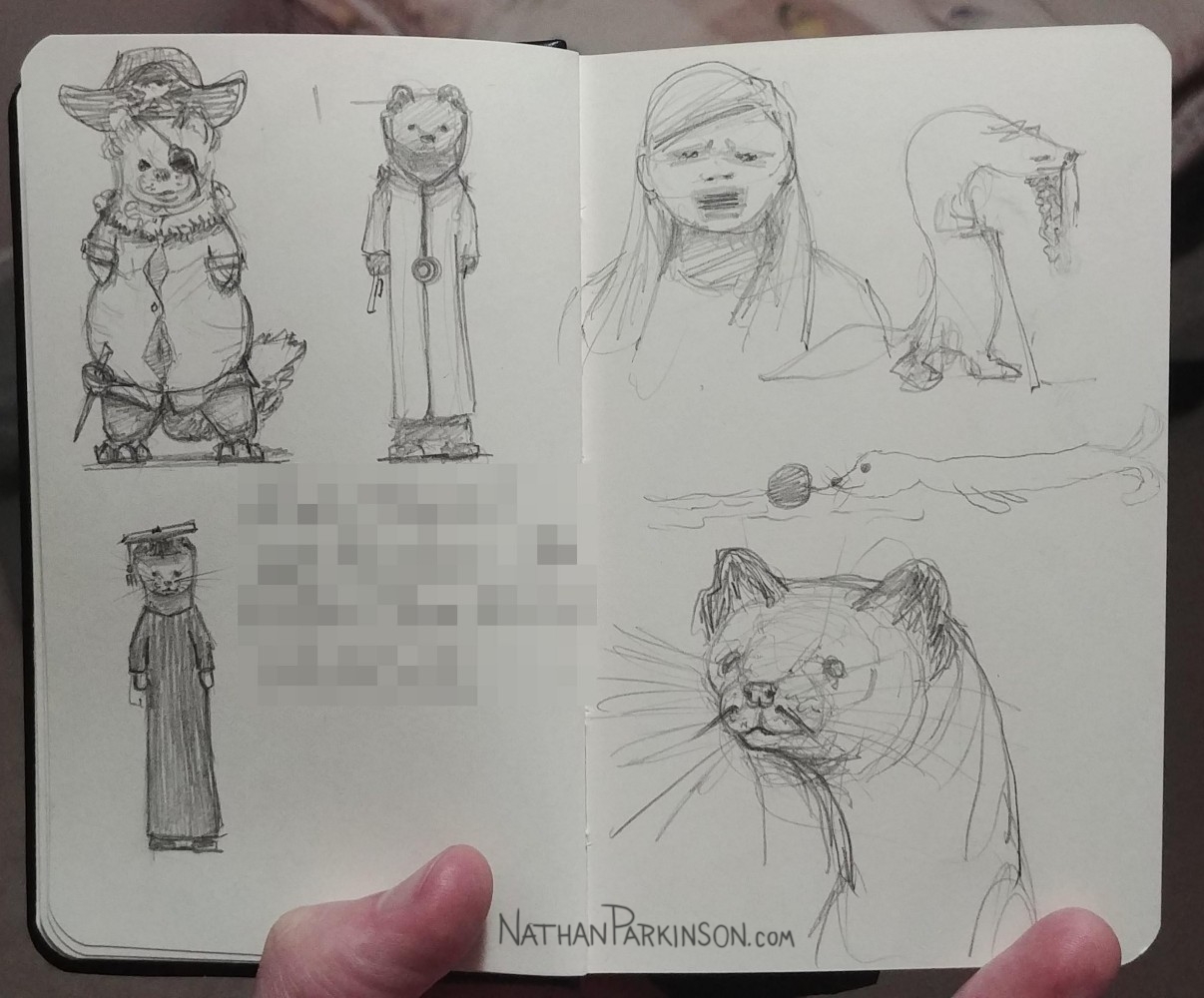
I requested feedback about anthropomorphism from people in the Mighty Artisan community and got some really useful advice about breaking the process down into simple steps. I tried applying the advice in the following pages.
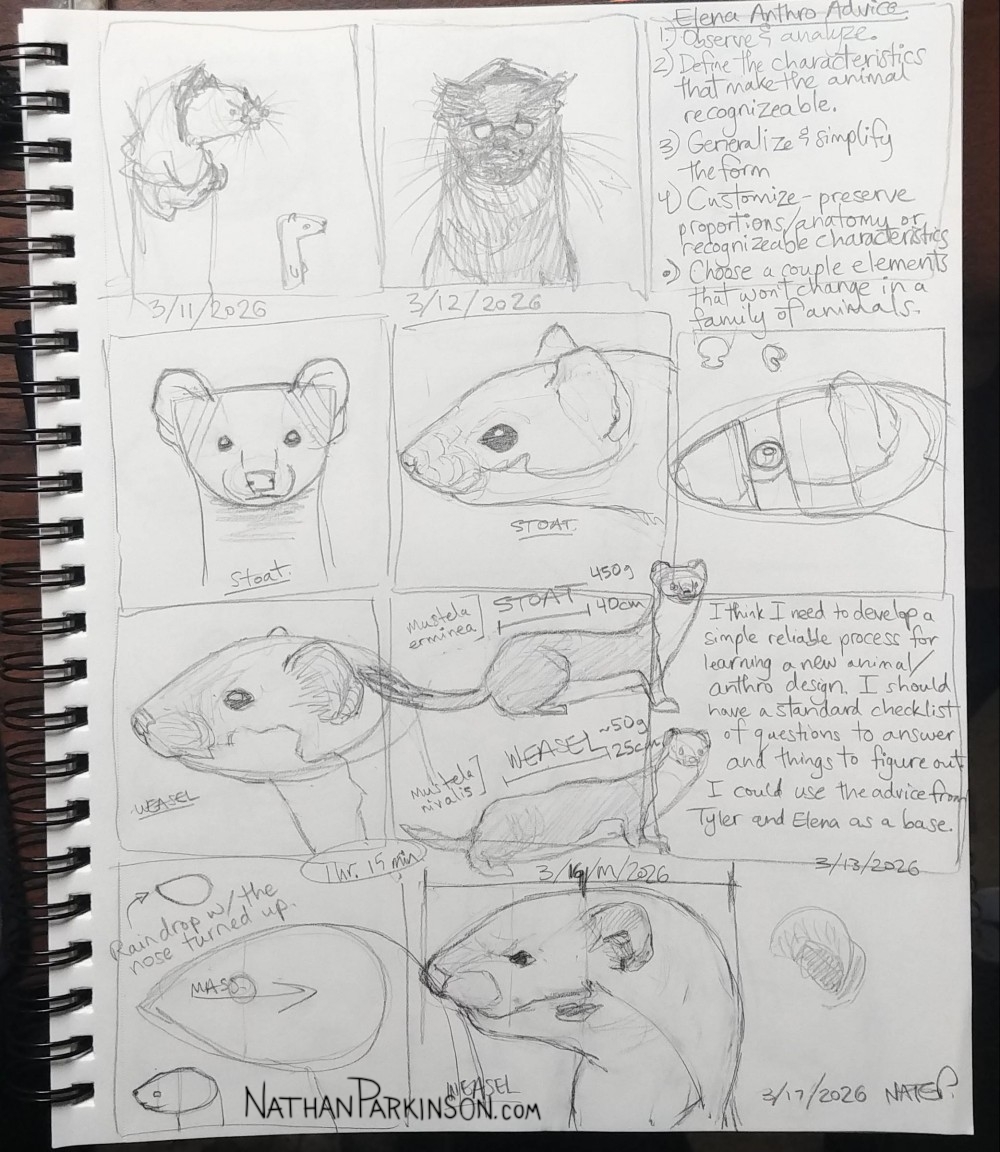
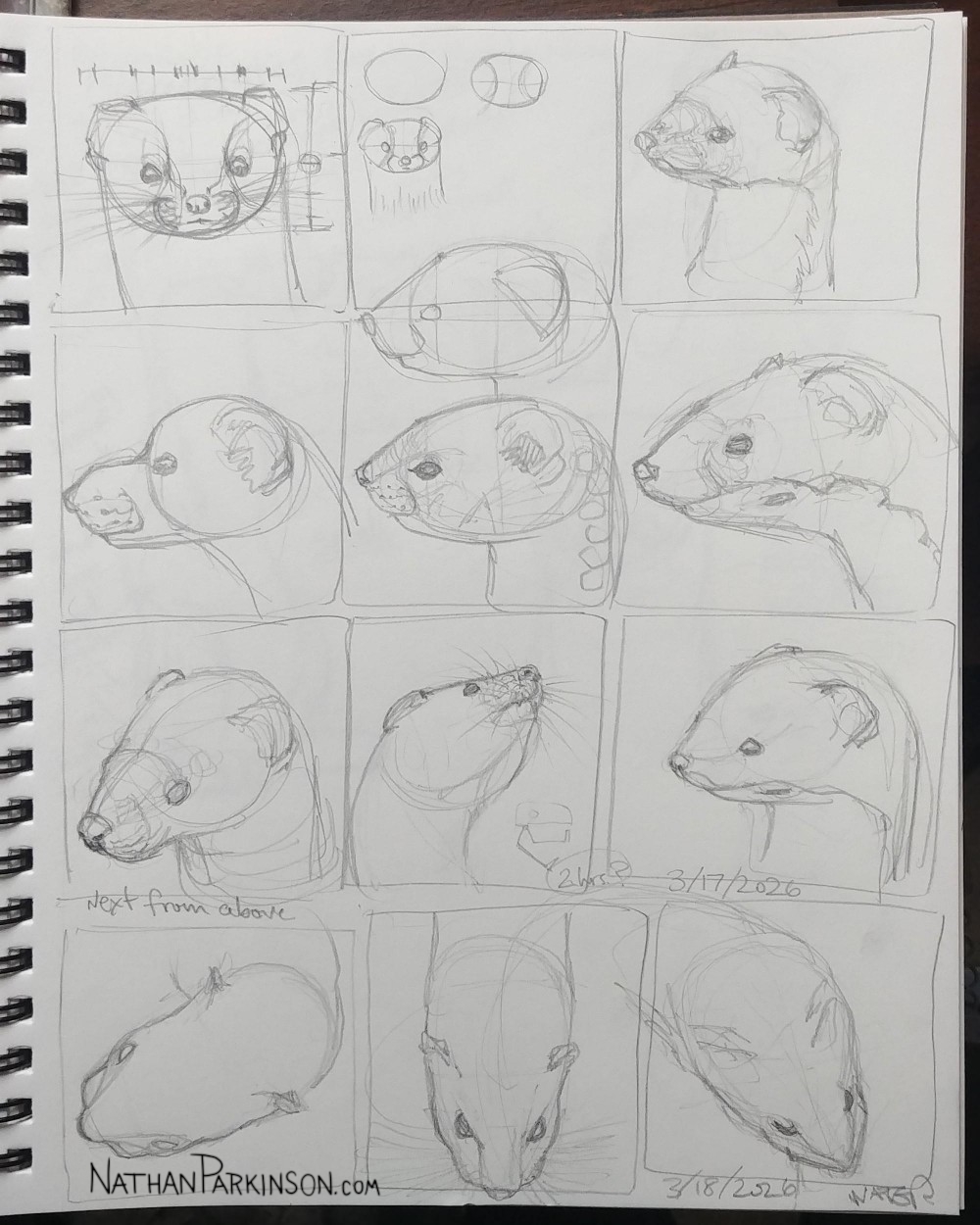
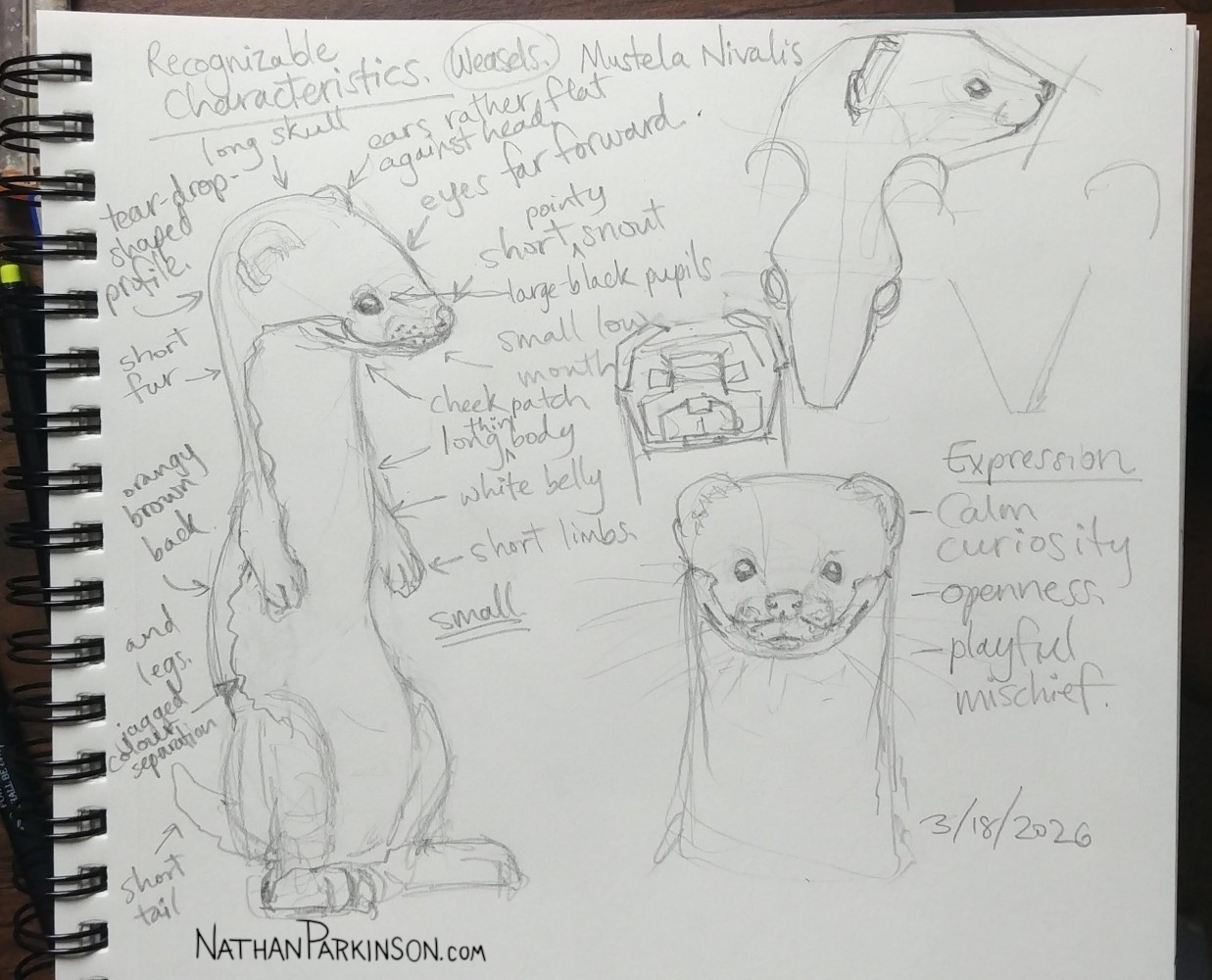
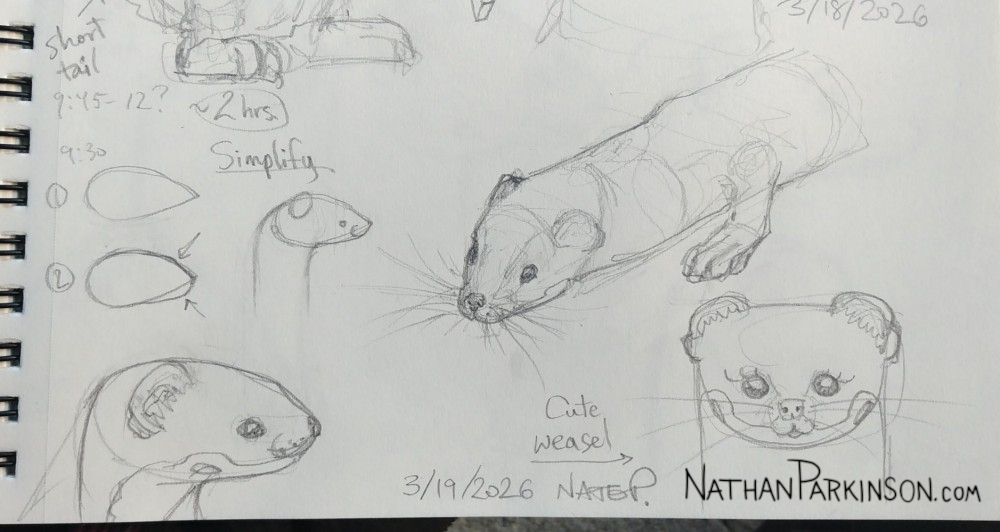
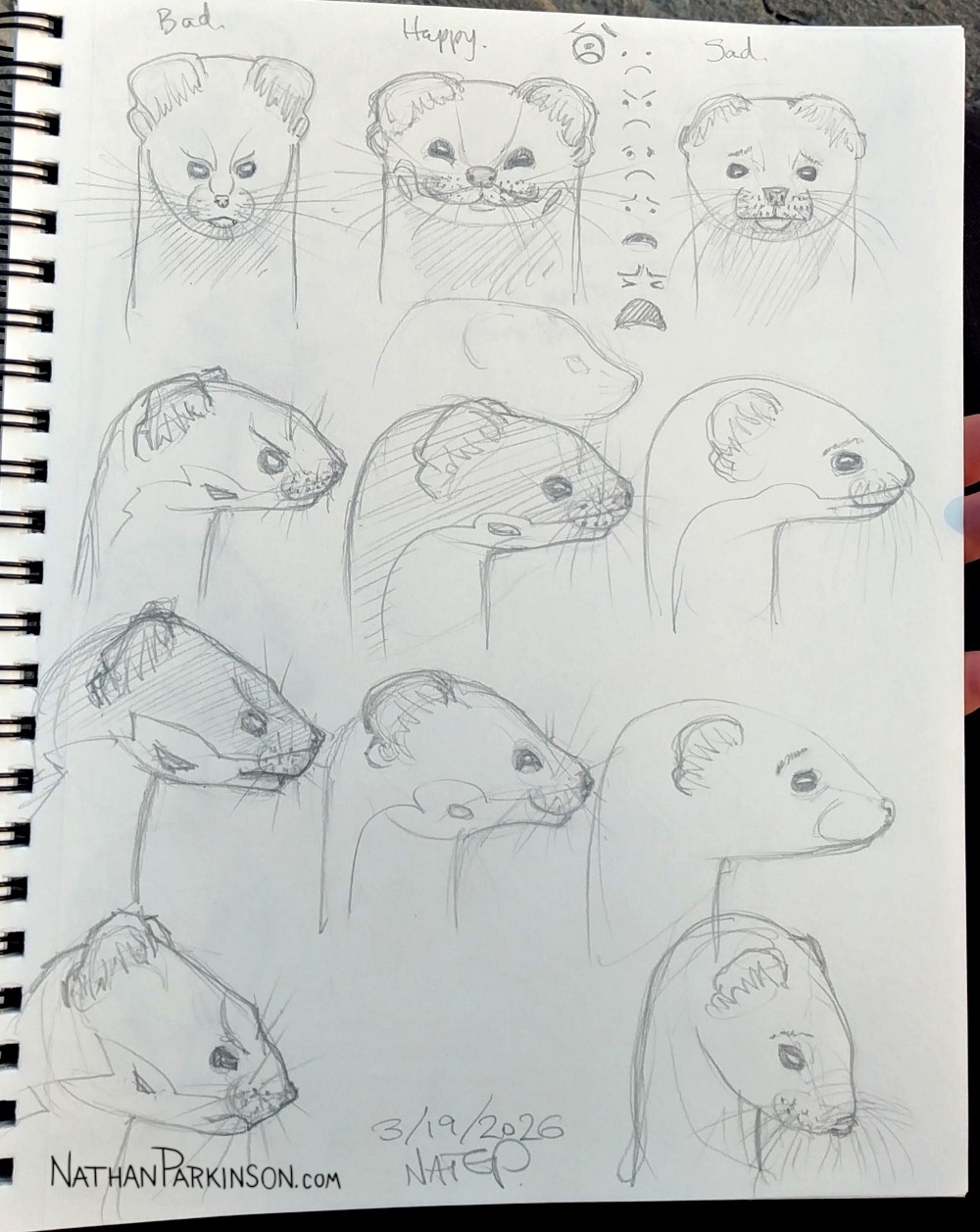
There’s a glimpse into what it looks like to study weasels. I plan to continue my studies for another couple weeks before moving on to a different animal. I’m also going to be trying to complete more illustrations in that period.
Have a great day!
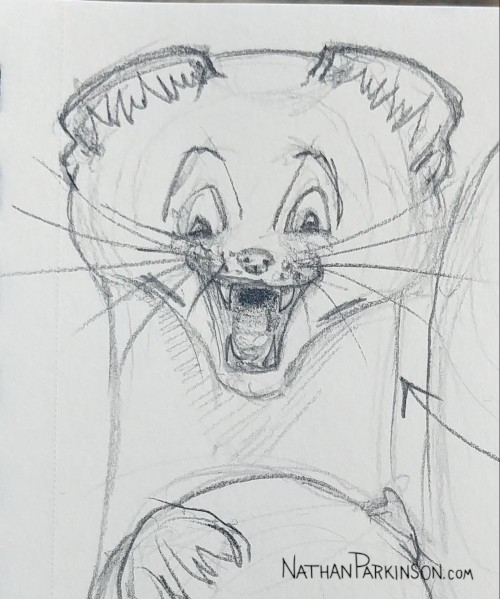
Having completed about 20 portraits in the Line and Color Academy, I will be moving on next to full-body characters. Here Mr. Octopus waves goodbye to our collection of portraits.

Having impactful colours in your images can do so much for the interest, even if the quality is rough.
This is a rough illustration I did a while back.

It’s got some fun action, but the colours, contrast, and saturation are weak.
I decided to see how borrowing the colour palette from the following image by Tim McBurnie could improve my image. I paid attention to the saturation and values. I probably just used the colour picker.

This is the result of my application of that palette to the same composition.

I think it gave the impact a massive boost. I also tried to add motion blur and a bit more of a painterly quality. Now the image throbs with intensity! What happens next!?
Here’s a side-by-side comparison of the before and after:
Don’t worry, he’s okay in the end 😉

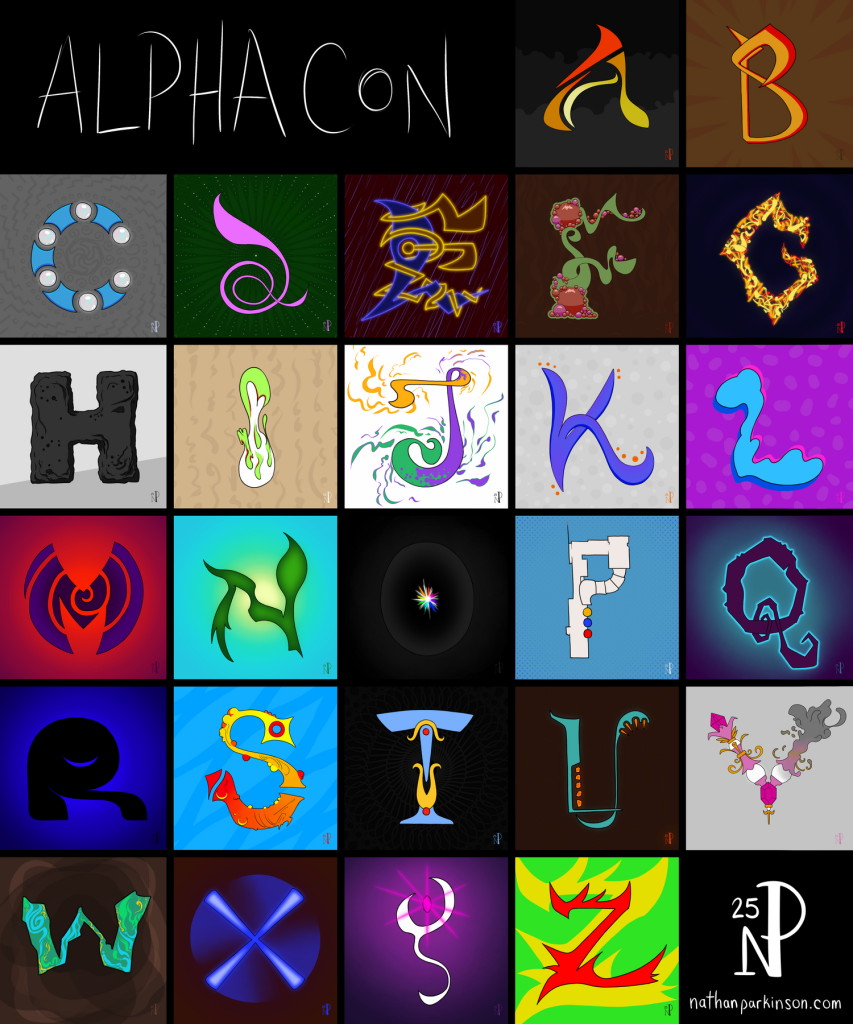
AlphaCon (Alphabet of Concepts) is an abstract illustrated alphabet. Each letter visualizes an abstract concept.
These illustrations are my first steps in developing a new line and colour style of art with Tim McBurnie’s Line and Color Academy. I started with abstract letters because I really enjoy this sort of design, but it also meant I didn’t have to worry about realism yet or things like anatomy and perspective.
Click on the following image to go to the art collection.
These are some of the most valuable resources I have encountered on my artistic journey: they’ve offered much needed guidance and have helped set my course. To give more context a few of the links will go to articles on my blog.

Mastery in Real-time – beyond seeing great finished artwork, there’s nothing to light a fire under you like watching masterful artists create in real-time, and share their thought processes. Here is a selection of my own influences:
There are many great recommendations from industry pros. I’ll list the ones I’ve actually read and found helpful (I’ve not read many):
These are additional resources I’ve found to be highly valuable, but have not yet integrated into the meat of the listings above.
I recently purchased Tim McBurnie’s Line and Color Academy through which I will be developing a new line and colour illustration style. One assignment has been to draw my Like List (all the stuff I enjoy drawing). I think I managed to capture about 95% of my written list on this page. I’m very satisfied with the result; ’twas a fun challenge.

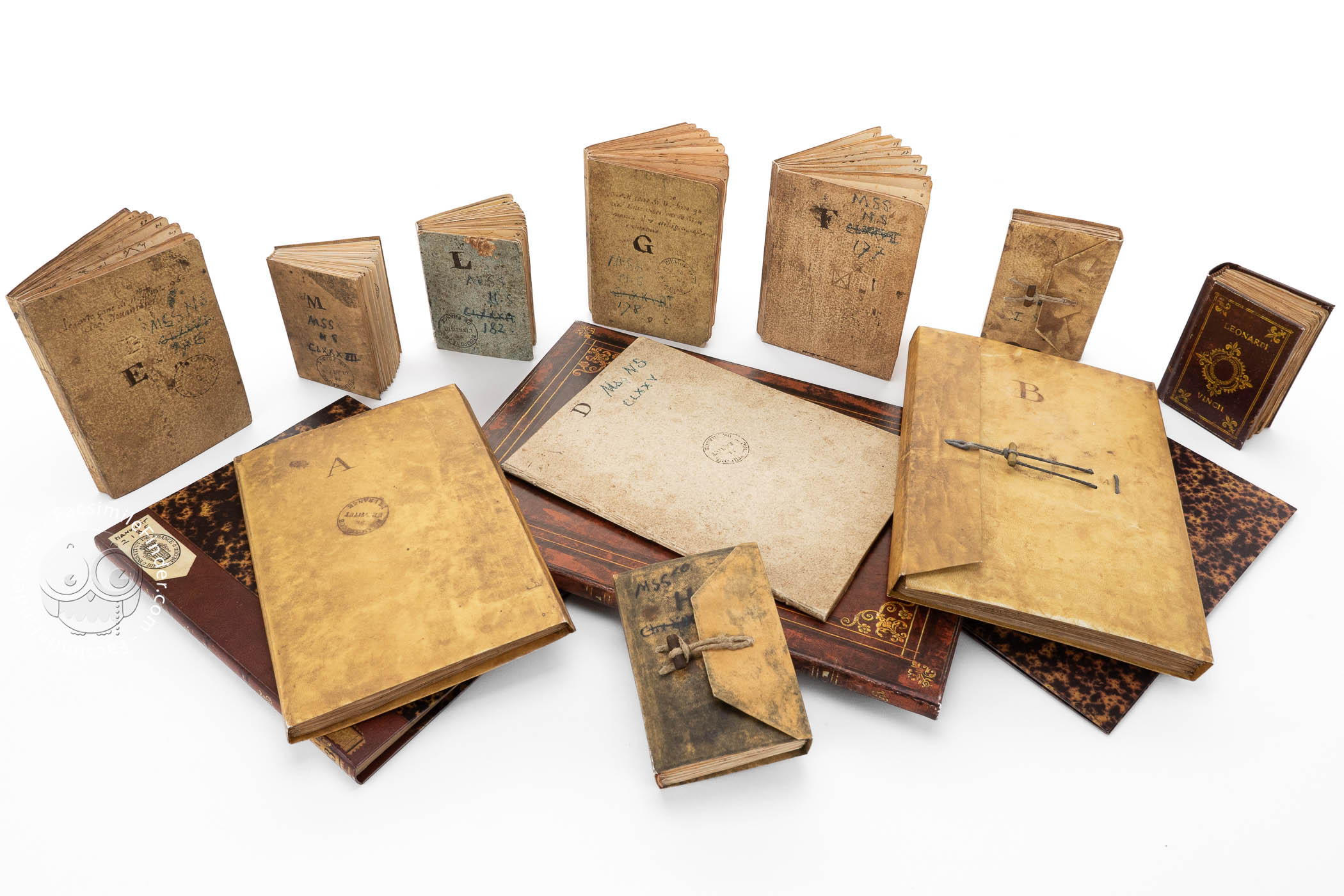
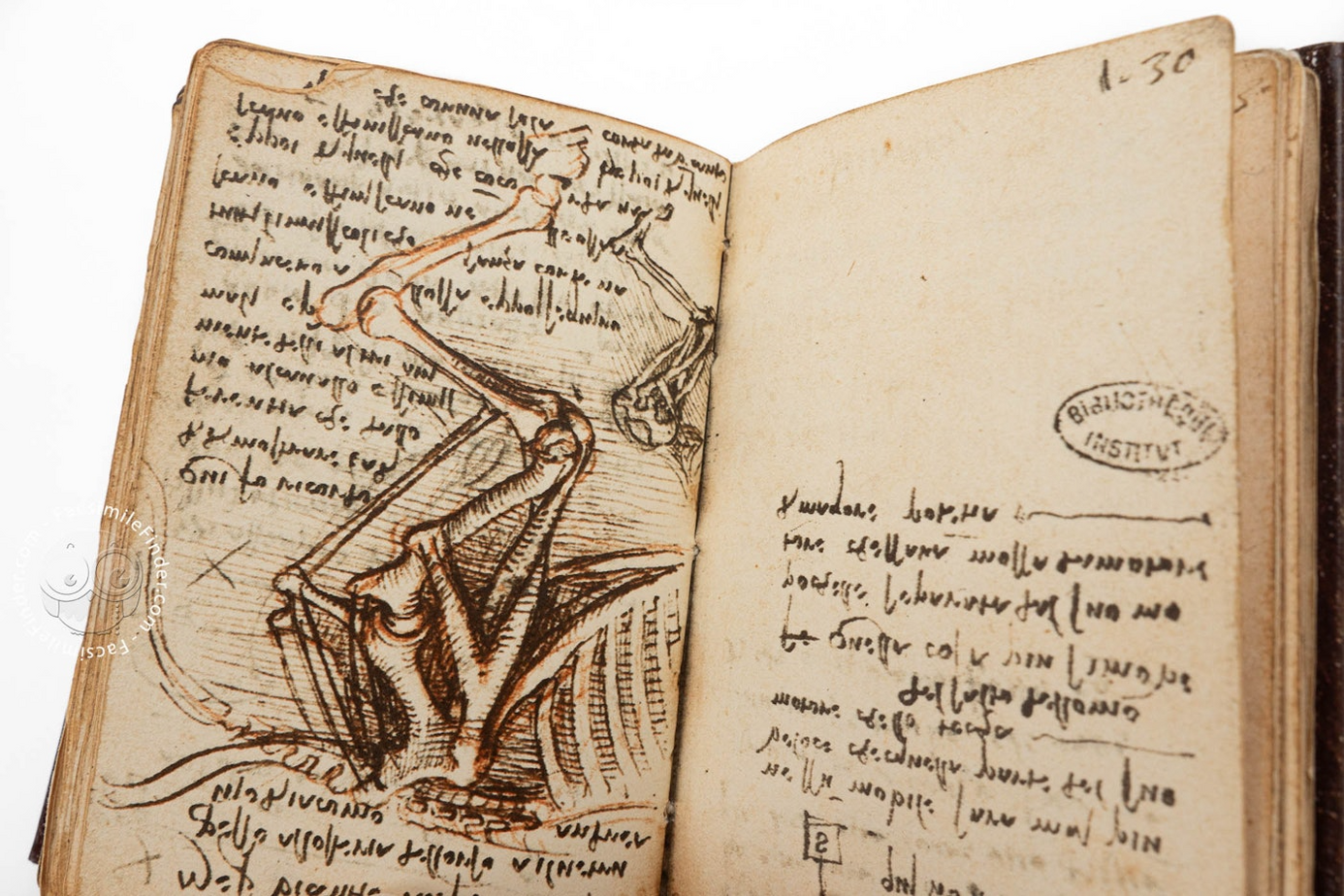
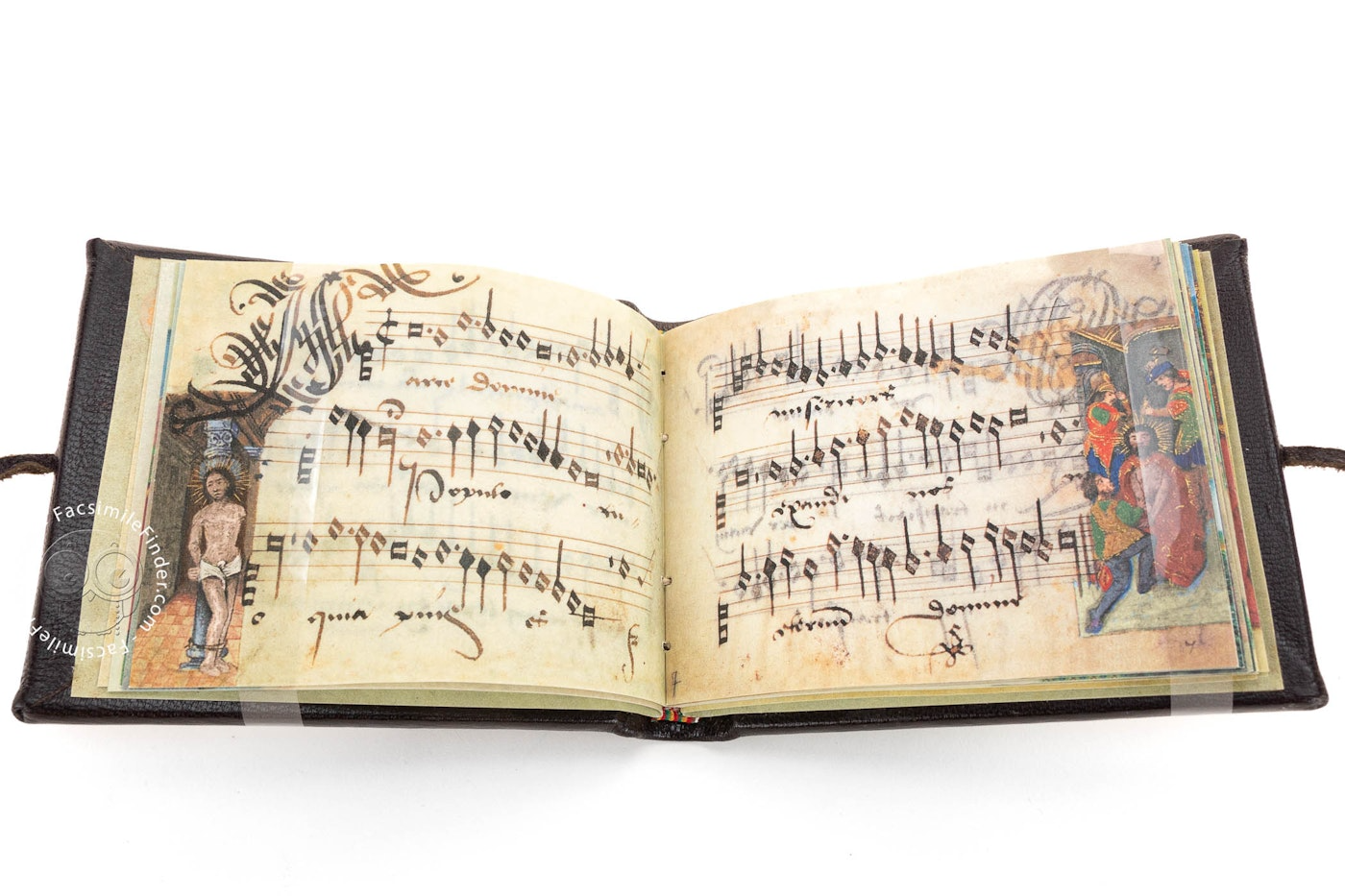
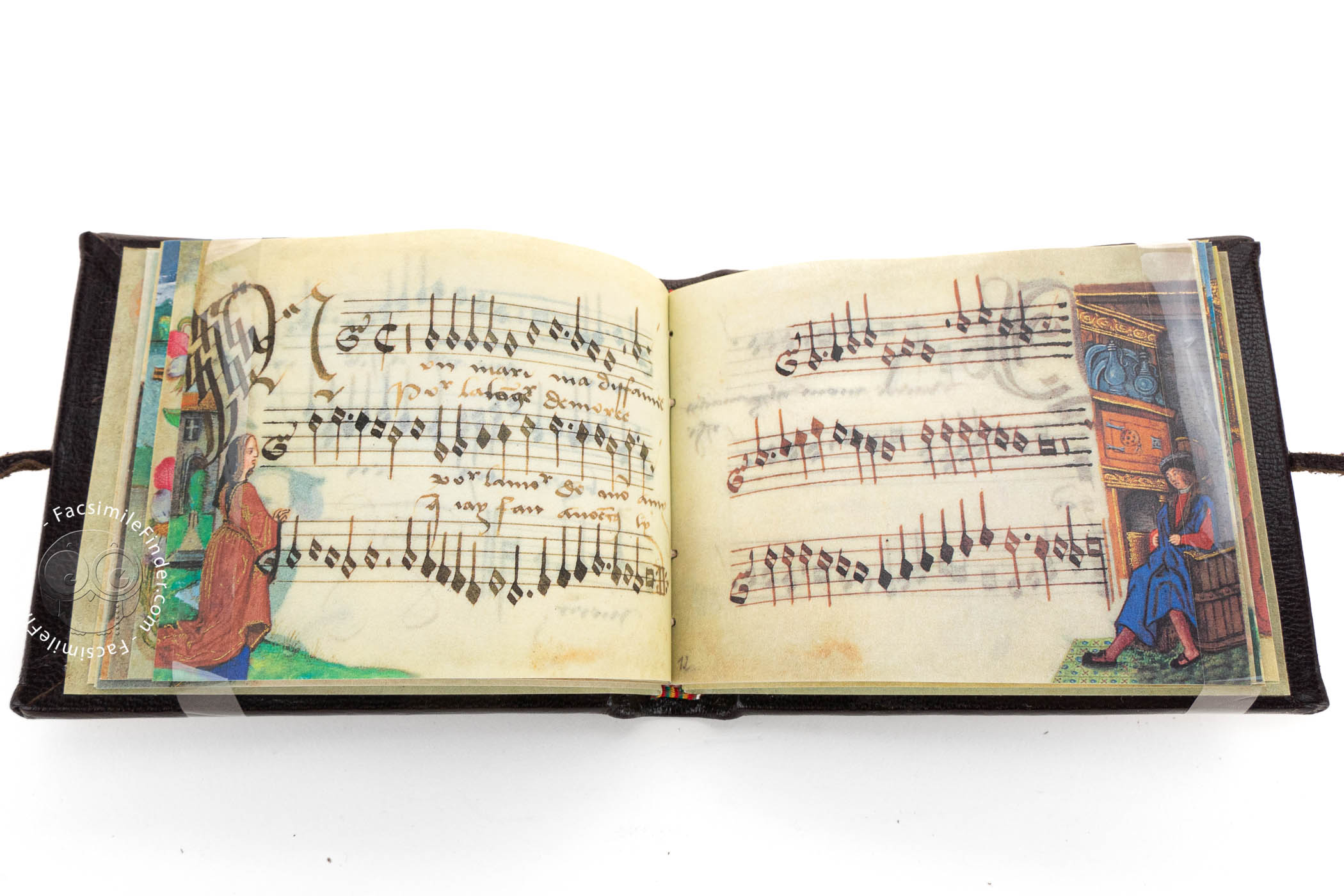
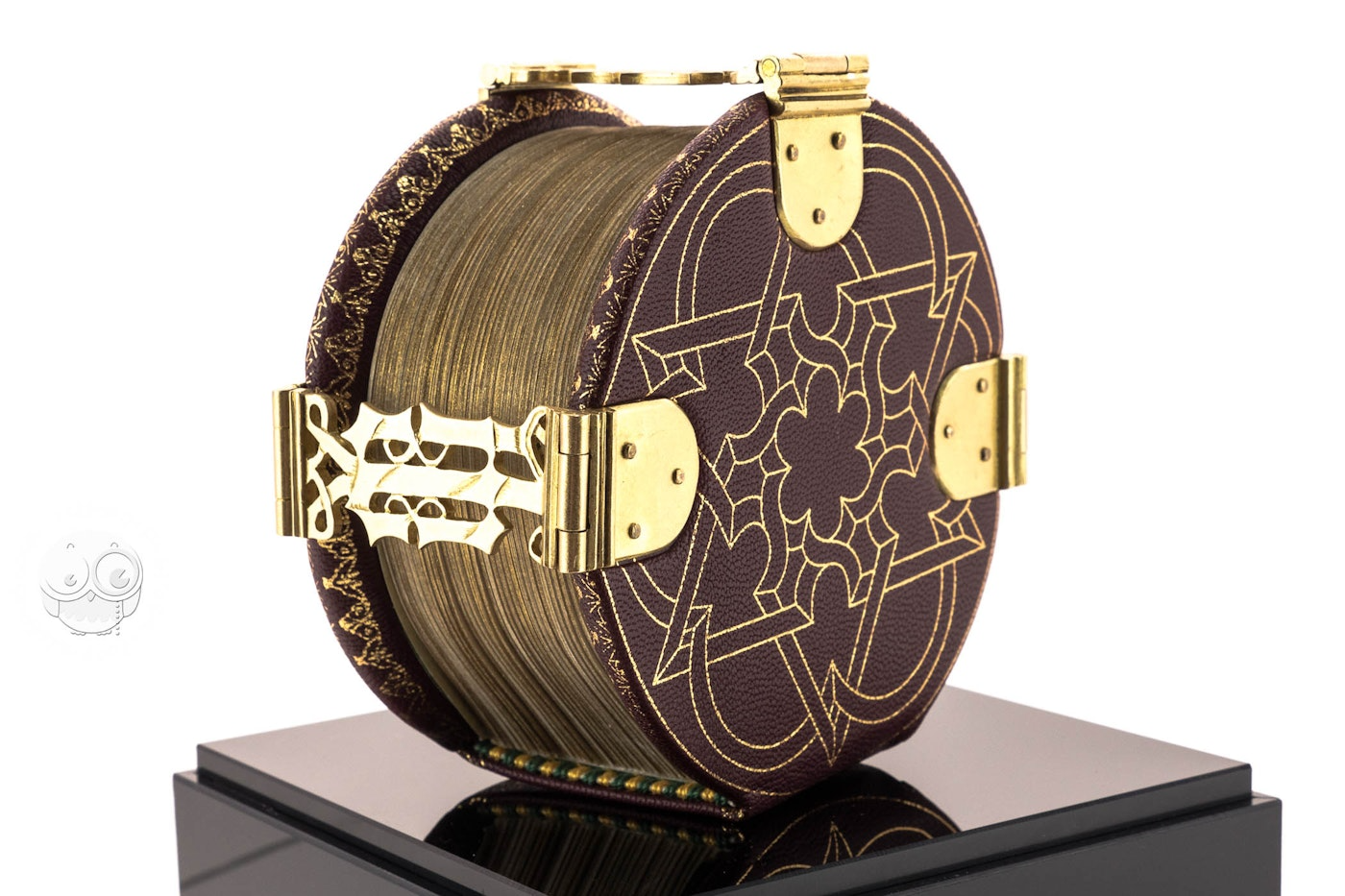
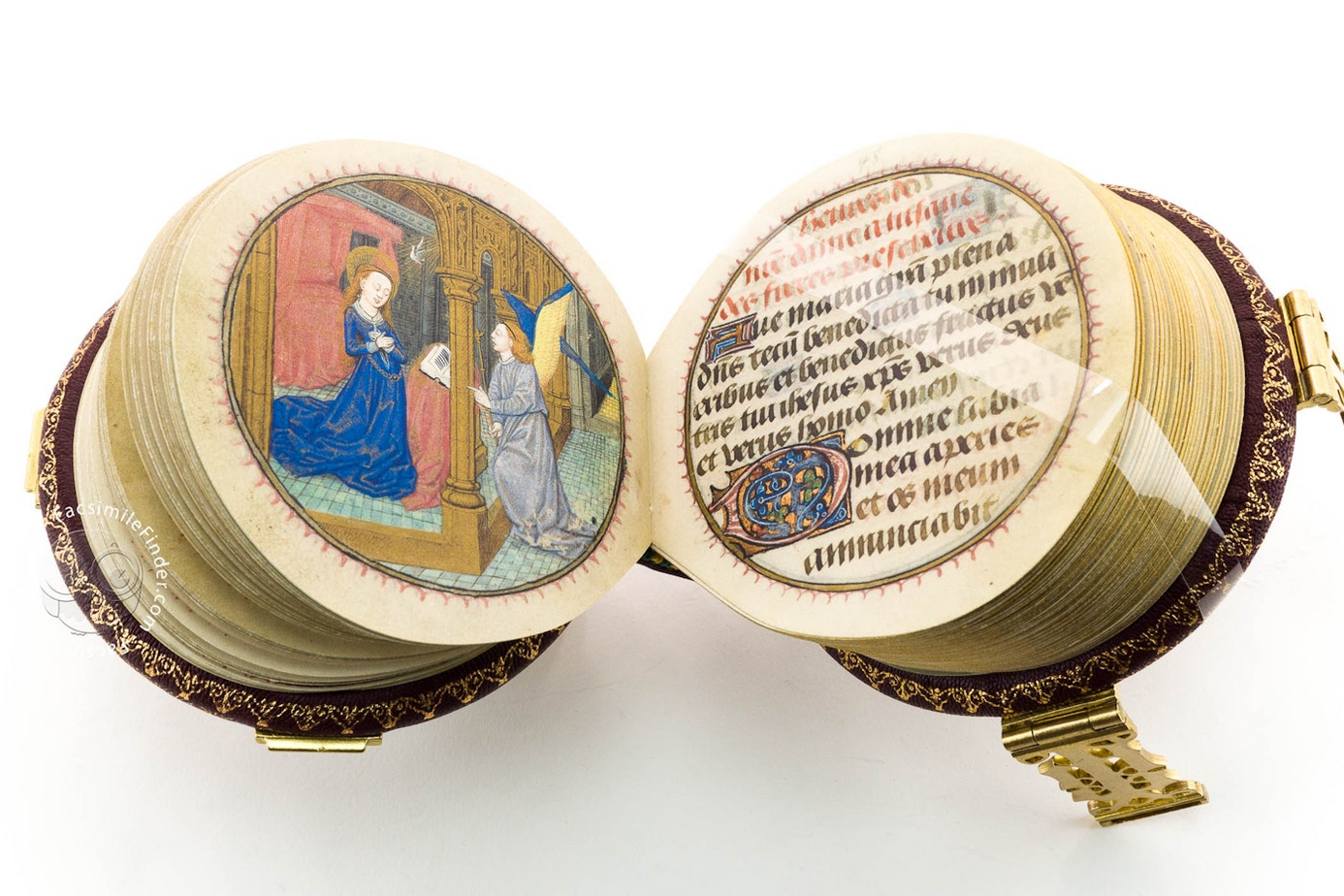
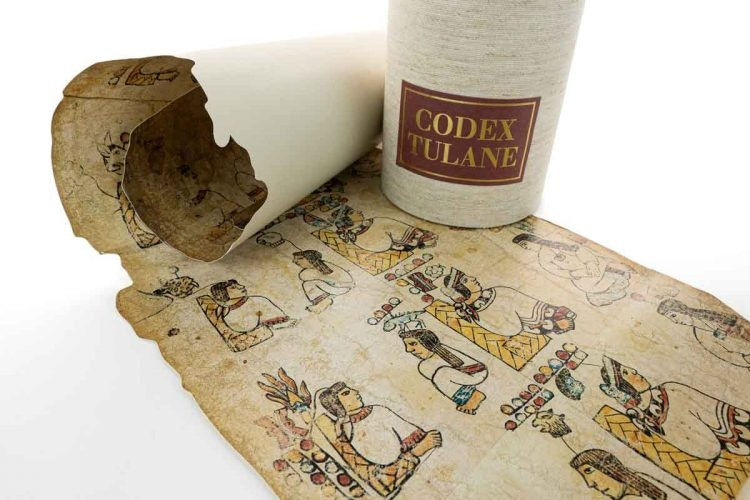
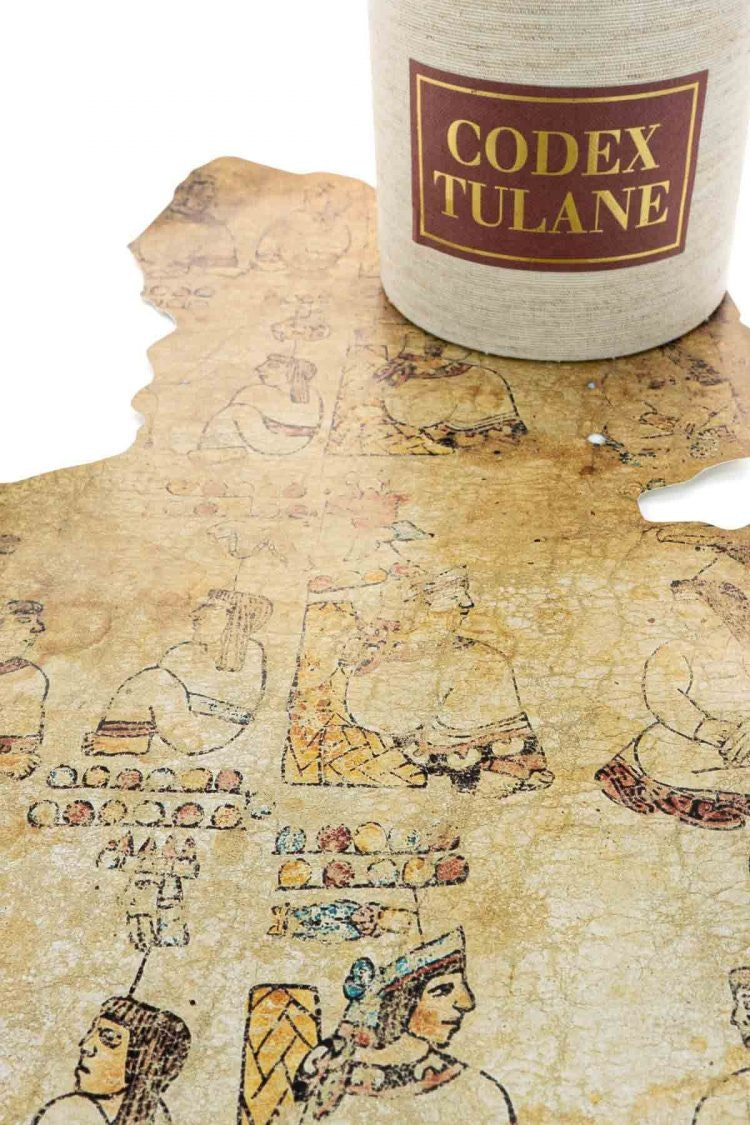
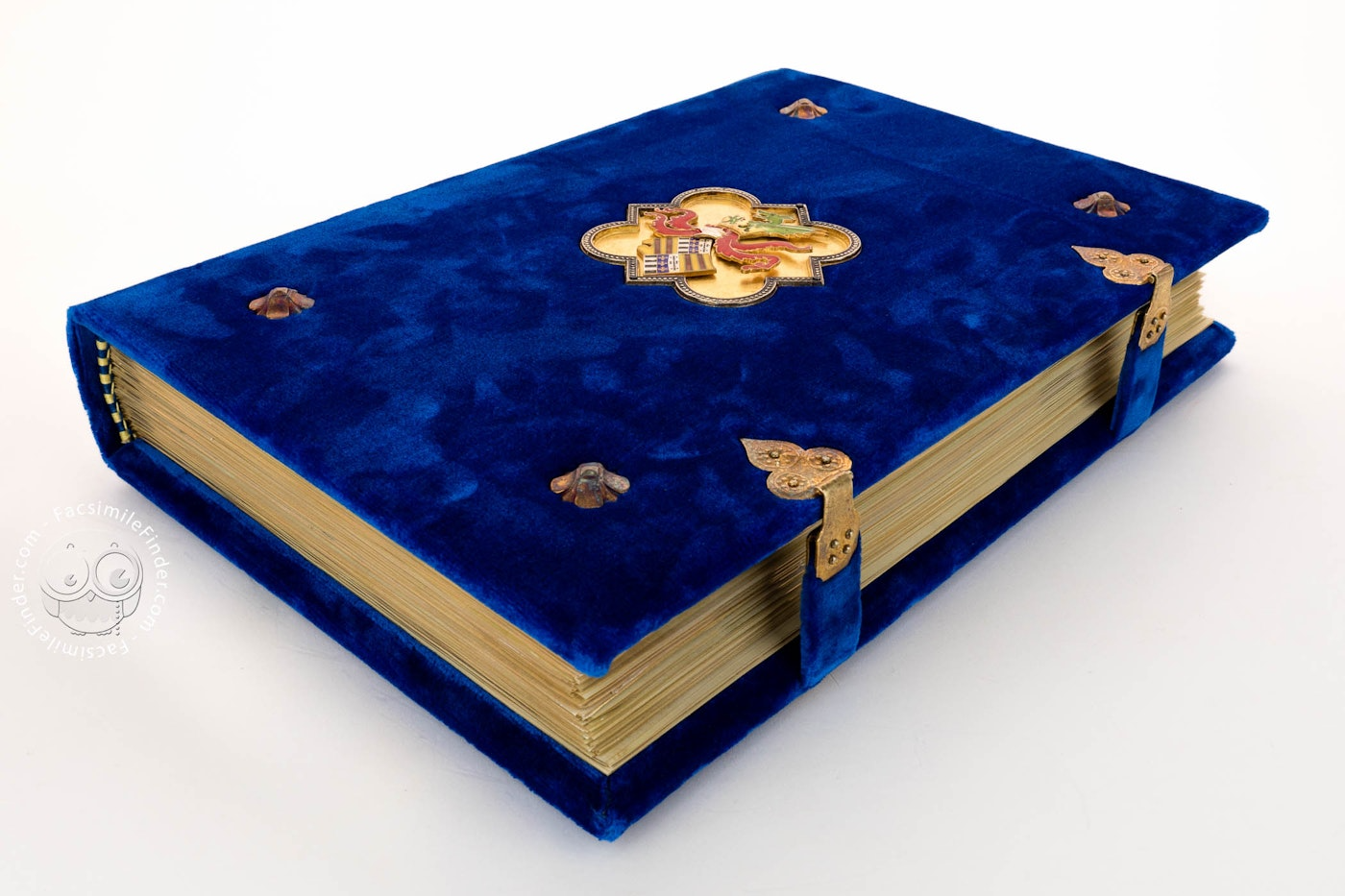
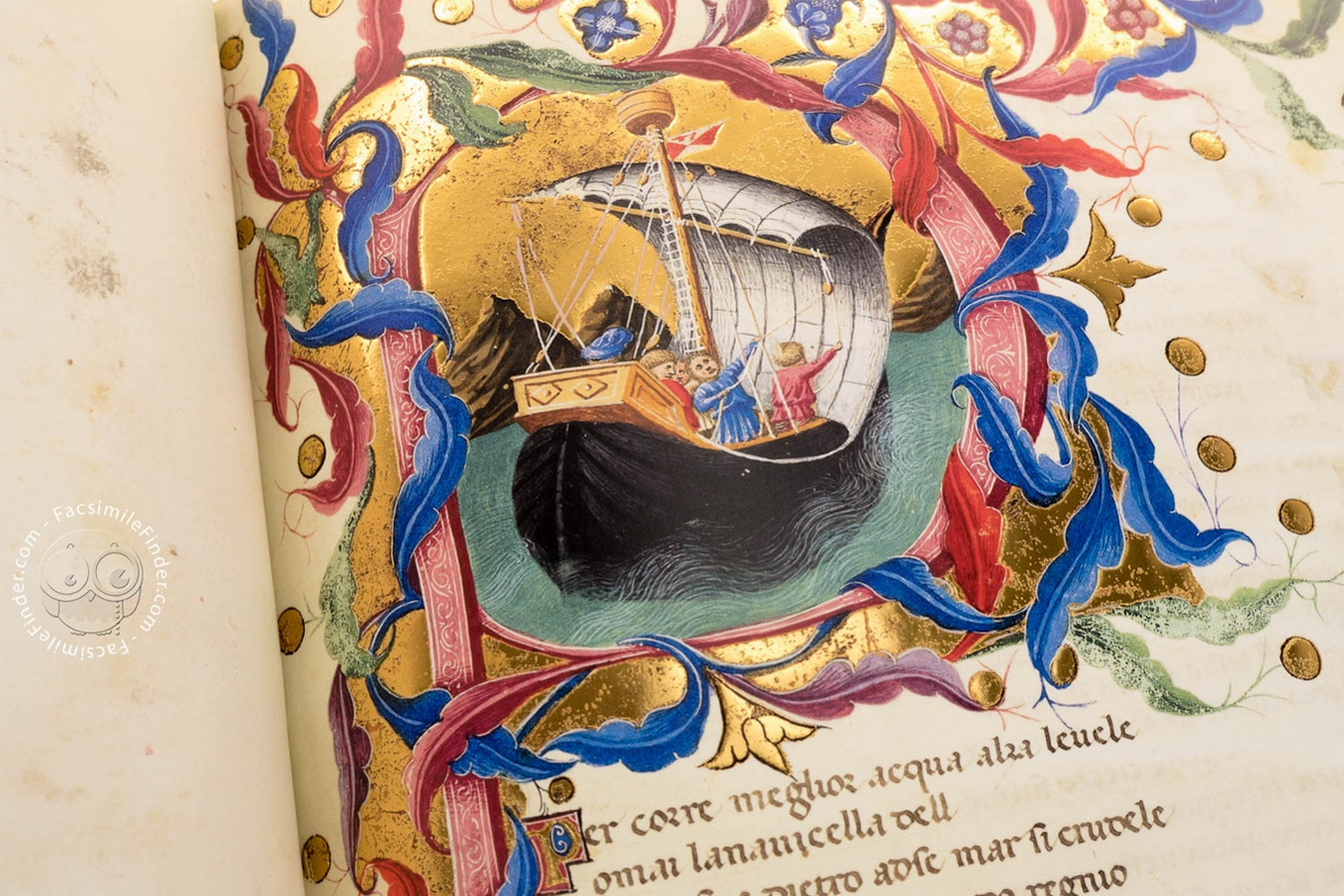
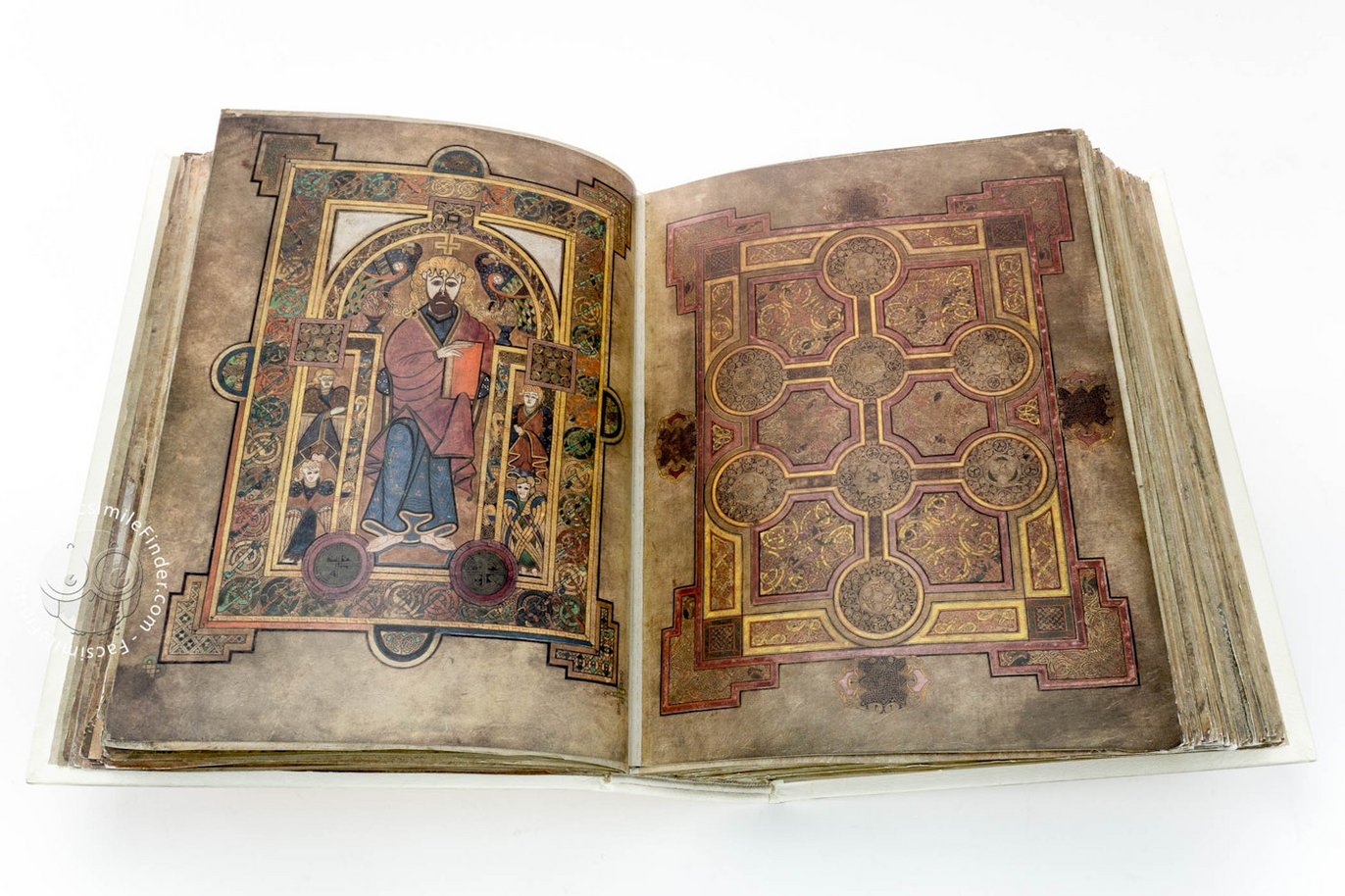
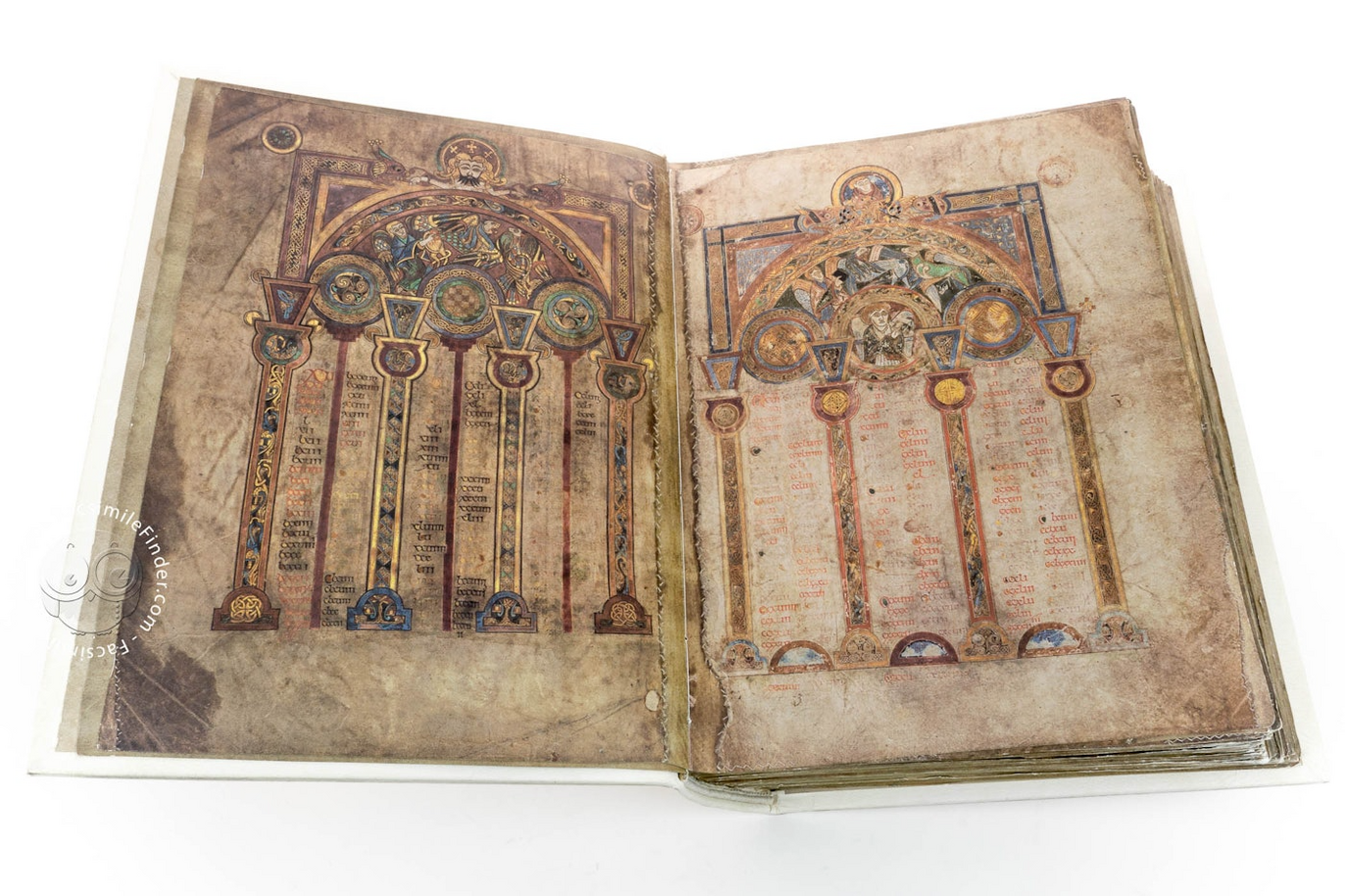
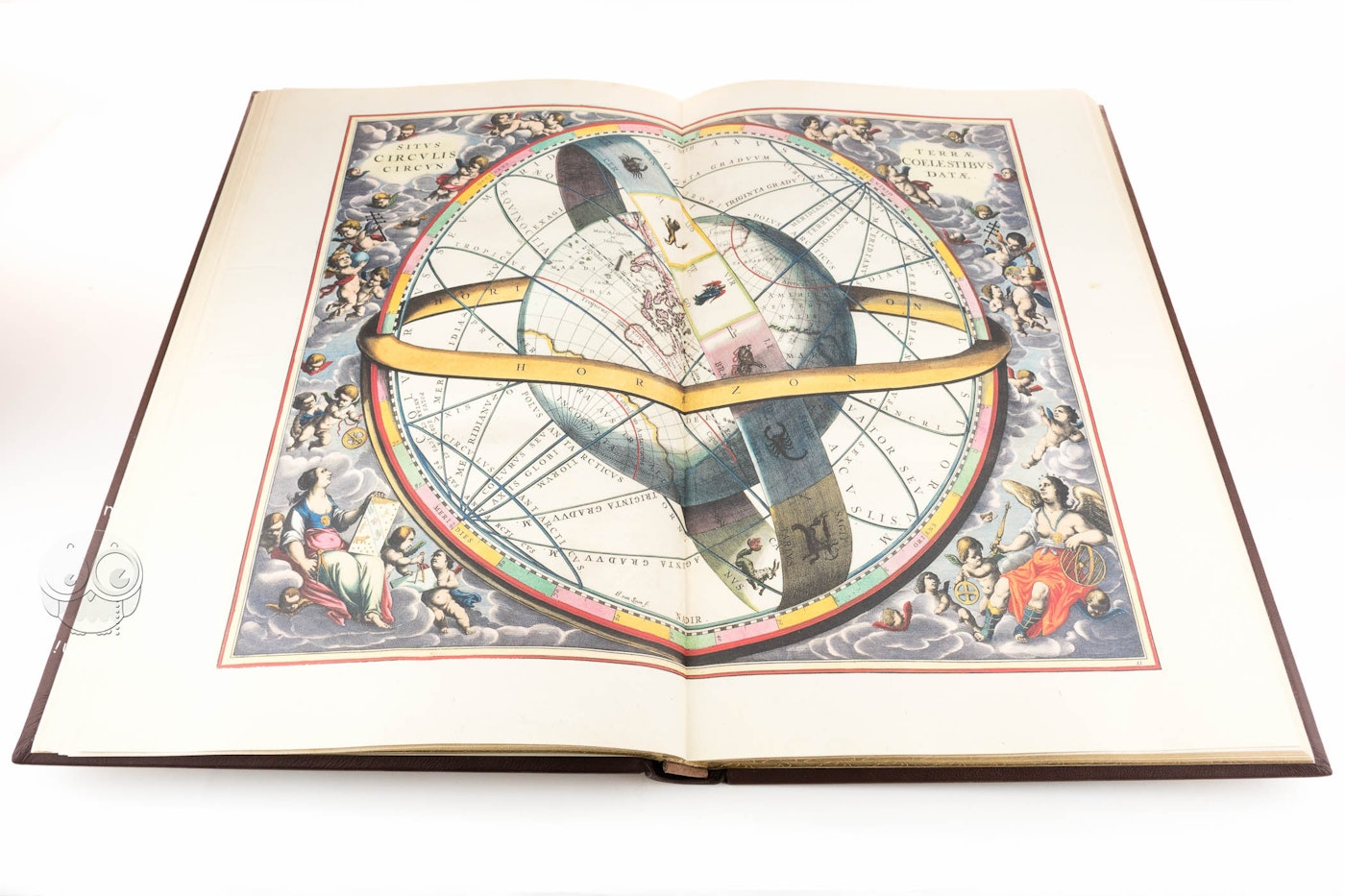
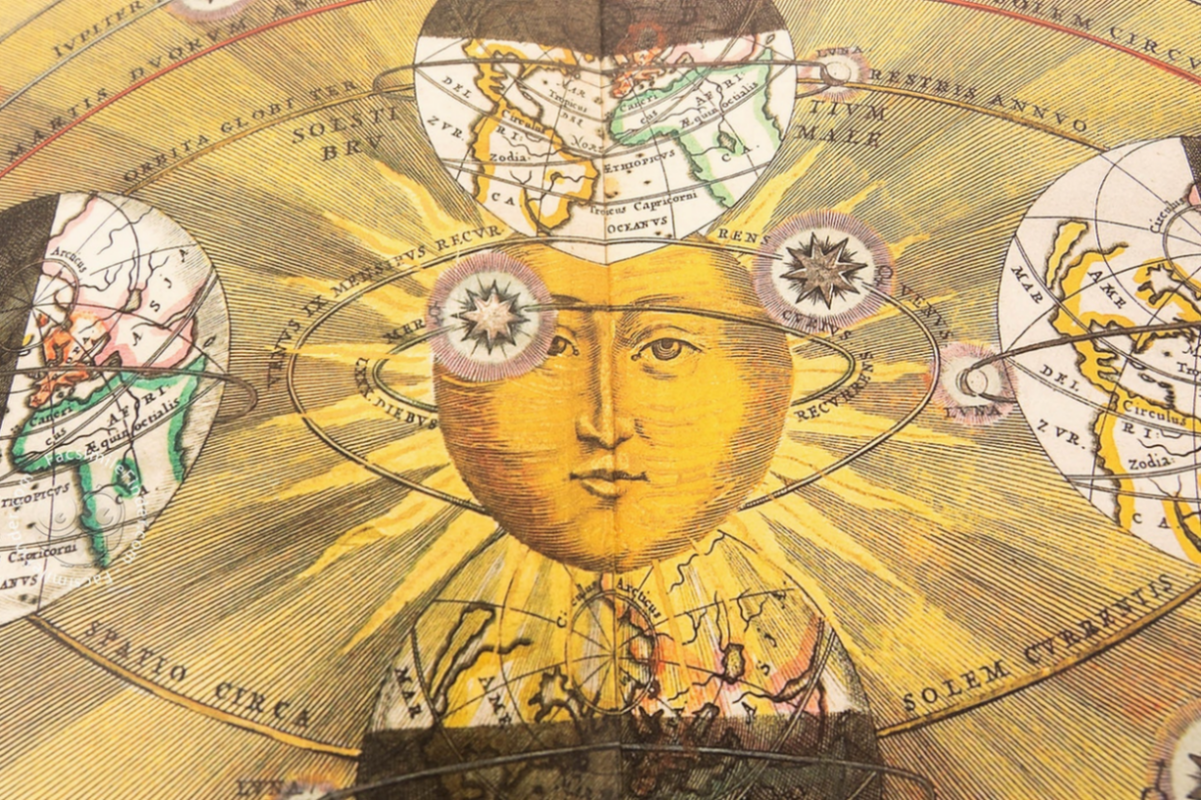
I found a really neat website that finds and sells facsimiles of old books, rolls, documents, etc. facsimilefinder.com. While the price tags are way over my head, they have some great photos and visuals. It is a lot of fun to look at the artwork and design in these relics. I’ll highlight a few I was impressed by. Keep in mind that these are replicas that you could actually buy if you had a few gold coins to spare. The artwork is just incredible . . . truly a window into the past. The following headers/titles link to the corresponding web pages.
In learning to write fiction for BREX, I discovered the concept of character-driven stories from Johnn Four’s article The 3 Line NPC Method: How to Create Story-Full NPCs Fast. Johnn writes the advice from his perspective as a Game Master for TTRPGs, but I have found his ideas to be superb for writing characters for fiction. A GM needs to be able to role-play his NPCs; a writer must also role-play his characters in abundant situations. I highly recommend reading and studying the entire article for all the goods if you think this idea may help your writing (it is lengthy), but the following link will take you to the specific section that lays out how to use the 3-Line NPC Method.
To sum it up, a 3-line NPC is a non-player character described in the following 3 lines: appearance, portrayal, and hook. Appearance is what you would first see upon encountering the character. Portrayal defines a few key role and personality traits and informs how to role-play the character. The hook is something meaningful, intriguing, exciting, etc. that can expand the plot of the story. Those 3 lines create a powerful package of details that makes writing for the character a joy because you know quite a bit about them from the start including motives and tendencies.
I like to create a bunch of characters before I need them to build up a reserve or library to draw from as the need arises for new characters. As a GM Johnn encourages introducing a new character each session to keep the story moving forward. I have adopted this mentality in my writing. I try to introduce at least one new character in each episode and so far (5 episodes in) I’m having a blast. I have had to create a couple characters to fit specific roles I had written about in my script and it felt less fun and free than writing random interesting characters and then dropping them into the story. I try to let character creation drive the story as much as possible rather than having to create a specific character to fit the story, but it does happen sometimes.
I was sold on the concept, but I’m very inefficient at coming up with interesting information to write characters; so I created a random generator to spark ideas which I can interpret into interesting elements. I now use this to create all the characters for my story. I still have to do a lot of the work for interpretting the details and writing the story hook, but this tool makes it so much more enjoyable. You can find and use my generator here: nathanparkinson.com/npc. You can even modify the source code and customize your own version however you’d like. I’d love to hear if you find this useful.
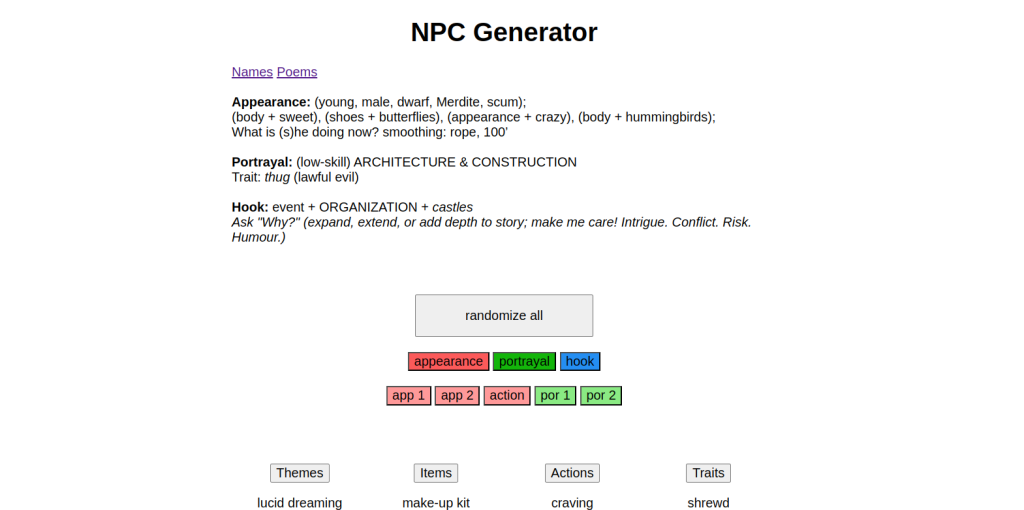
To give a proof of concept, I will provide a few 3-line NPCs I have generated using this method. You can find explanations for each section at the bottom of the generator page.
Appearance: (middle-aged, male, dwarf, Merdite, peasant); simple stylish hat, short beard, fiery red pants; impatiently sorting through ring full of keys to unlock something; yelling at students kissing in the library.
Portrayal: (low-skill) Librarian – administers or assists in a library.
Amateur bonsai arborist; impatient; blunt; short-tempered, emotionally fragile (lawful neutral)
Hook: A former circus tamer. Due to an impatient mistake he made his son was killed in the ring by a beast. To distance himself from the memories he left the circus and took a position as a librarian. He is learning bonsai to try to improve his patience; he succeeds sometimes. He is often lost in a cloud of emotion, presented as impatience or distance, as he processes his grief; he misses his son.
Appearance: (elderly, male, giant, Ursmite, wealthy); epic hair, metal-plated pants, elaborate silver flute on waist; negotiating in the market about castle business.
Portrayal: (high-skill) Guild Master – leads an economically independent producer (a “guild,” an association of craftsmen or merchants that often holds considerable bureaucratic power).
Sweet odor; swift; duplicitous (neutral evil)
Hook: In jealousy he betrayed his ‘best-friend’ to death and deceived the family that he did all he could to save him. In gratitude they gave him a special family heirloom, a silver flute. It is said that the darkness of his heart corrupted the life stones in the flute, cursing it never again to play a joyful melody.
Appearance: (middle-aged, female, human, Merdite, destitute); tattered feather dress, bird’s claw clutching strange stone hangs from neck, small birds flit around her; fighting to keep a large bird in a cage.
Portrayal: Fowler – catches or ensnares birds.
She loyally served one of your relatives in a naval capacity; always smells nice/wild (chaotic good)
Hook: She needs your help to save her naive daughter from the scumbag pursuing her. She has convinced him that buying her daughter a certain bird will win her heart, but she knows it will drive them apart. She wants to use Brex as bait for the bird.
If you’ve spent much time in the art world, you’ve probably heard of “the fundamentals” and how important they are. Over the years I have studied how making art actually works and how to accurately define the many components. “Why is this useful?” By breaking a skill into its individual parts, you can practice each one more intentionally. Trying to learn everything at once or with a vague focus can make it harder to recognize your progress. For someone trying to master their craft, having a solid comprehension of the tools available is important.
The result of my efforts is the Fundamentals of Art document that I am now offering for free download.

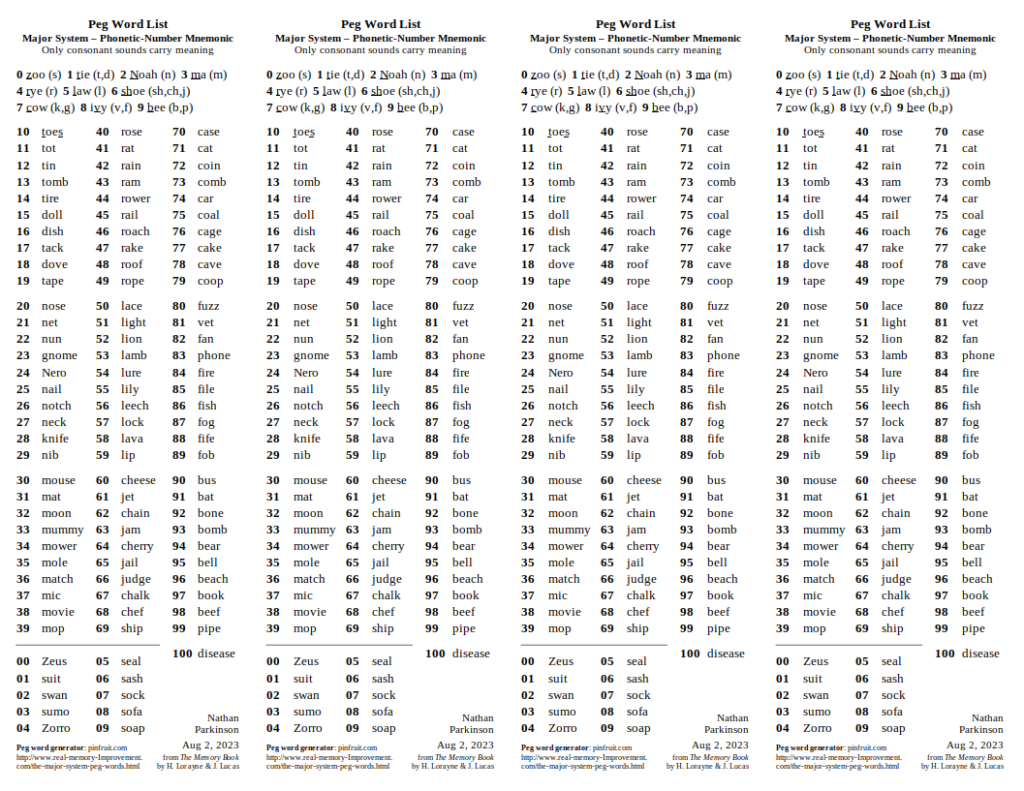
This post is generally unrelated to art, but it features an extremely useful and versatile tool for remembering anything – the Major System peg words (see my full PDF list below). The Major System is a mnemonic technique which encodes numbers as consonant sounds (or in this case, groups of similar sounds); the consonants are mixed with vowels to form words; the resulting words serve as mental pegs upon which to hang (i.e. associate) things you want to remember. The following list is an example:
To use peg words for memorization, first learn the numbers with their sounds; then use the sounds to memorize a word list. Next create a mental association between each item from the list you want to memorize with the corresponding peg word. In your mind see the two items interacting in a bizarre, memorable way – in doing so you are hanging the item on the peg for later retrieval. Mentally-visually associating two things is the most effective way to remember something easily because it takes advantage of how the mind optimally works. This system enables you to memorize lists and recall the exact numbered position of every item in the list.
This system is very useful for memorizing passages of Scripture (even entire chapters and books) as you can create and recall an association for the beginning of each verse and link it to the peg word for that verse number. This association acts as a prompt for starting the verse.
I first learned of peg words from The Memory Book by Harry Lorayne and Jerry Lucas (this book is a fantastic resource for all things memory-related). You may be asking, “Why go through all the trouble of learning a whole memory system when I can use something more simple like one-bun, two-shoe, three-tree, etc. to accomplish the same thing?” The answer is extensibility. If you only want to memorize a short list of ten items, then more simple systems are great; but what if you want to memorize 50 or 100 or an undetermined number of things? Rhyming, alphabet, and other small-scale systems are limited in their scope. Using the Major System makes expanding your word list relatively easy by providing a predictable, consistent system which allows you to move between number and sound with ease (once you’ve memorized it and practiced, of course).
I’ve created a compact printout for the first 100 peg words. I started with a word list from this source (which also has a great explanation of using the Major System), and then changed some words to fit my taste. The following PDF printout contains the peg word list in a compact format four times; so you can cut the page into four sections to create bookmarks or share with others. I hope the PDF is useful.
Learn more about the Major System:
You may find the following website helpful in creating your own Major System peg word list: pinfruit.com.
Though it is disputed who first made this exact statement, I think it was marvelously said:
“Everyone is a genius; but if you judge a fish by its ability to climb a tree, it will live its whole life believing that it is stupid.”
Though, I believe an important distinction should be made: if you judge the fish unwisely, then you (not necessarily the fish) will believe the lie; only if the fish judges himself by erroneous standards will he believe himself to be incompetent. When we judge ourselves according to truth, we can have great confidence (with humility) despite the dismissive nature of others.
This also reminds me of a quote by Mark Twain, “The two most important days in your life are the day you are born and the day you find out why.” I believe God has made each person uniquely special; there’s not another person exactly like you; so try lots of things till you find what you were made for and as Jim Elliot said, “Wherever you are, be all there! Live to the hilt every situation you believe to be the will of God.”
Read more wise & witty sayings.
Updated December 3, 2022
In an interview of Orson Welles by Dick Cavett, Welles recounts the following situation early in his career. While beginning to make his first film, Citizen Kane, he was approached by cameraman Gregg Toland.
[Toland enters Welles’ office . . .]
Toland: I want to work in your picture; my name is Toland.
Welles: Why do you, Mr. Toland?
Toland: Because you’ve never made a picture, and you don’t know what cannot be done.
Leading up to his description of that brief conversation, Welles makes the following statement: “. . . Ignorance – there’s no authority in the world like it.” Welles’ and Toland’s statements really caught my attention. I’ve seen a similar saying by Shunryu Suzuki: “In the beginner’s mind there are many possibilities, in the expert’s mind there are few”; that brings a couple more to mind: “It always seems impossible until it’s done” (Nelson Mandela), and, “They did not know it was impossible so they did it” (Mark Twain).
Inexperience is both a blessing and curse. Being blind to what is and is not possible, you may be willing to take risks more-experienced people would not; you’ll bring a fresh perspective and perhaps even attempt to do what others know “cannot be done”; that means you’ll probably fail quite a bit, but in challenging assumptions you will discover which ones are true and which are false. Young blood can really shake up an industry.
I greatly appreciate the wisdom of Solomon to “Take fast hold of instruction; let her not go: keep her; for she is thy life” (Proverbs 4:13); listening to the counsel of wiser people is vital to our growth; but I also see value in respectfully, humbly challenging the presuppositions of those who came before us and proving the truth for ourselves. As another wise man once said, “Just because something seems impossible, doesn’t mean it isn’t easy” (Parkinson’s Law #21, T. S. Parkinson).
Citizen Kane went on to be enormously successful; though, I’ve not seen the film in a while, so I don’t necessarily recommend it, but rather the philosophy described by Welles and the others I’ve mentioned. Though experience is certainly desirable, your being a novice doesn’t have to be a negative.
Read more wise & witty sayings.